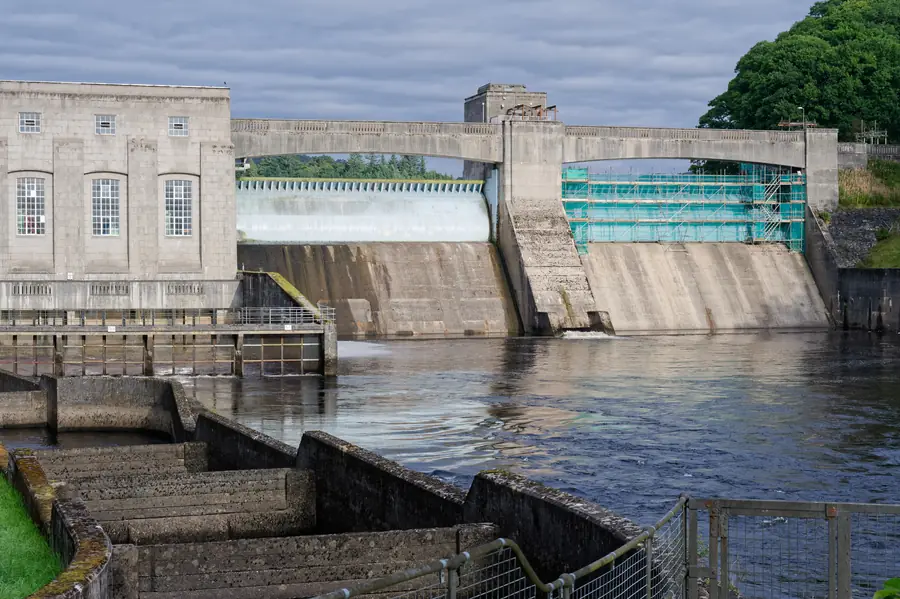
The Pitlochry Fish Ladder sits beside the hydro dam on the Tummel, about ten minutes’ walk downhill from Atholl Road, and it exists because the dam blocked a salmon river. That is the whole story, and it is a better one than the phrase “visitor attraction” suggests. You come for the fish. You stay for the concrete, the loch behind it, and a free half hour that most people in the town never quite budget.
The attraction page covers the facts. This is how to use the ladder on a morning, a wet afternoon, or the start of the loch circuit.
Pitlochry Dam was built for the Tummel–Garry hydro-electric scheme in the late 1940s and finished in 1951. It holds back Loch Faskally, a three-mile reservoir on the river, and it still feeds the grid. When it went up, Atlantic salmon that had run this system to spawn upstream had nowhere to go. The North of Scotland Hydro-Electric Board was required to give them a way past.
The ladder is that way: a concrete staircase of pools climbing around the dam so a fish can rise the height of the wall a metre at a time. The dam itself is about sixteen metres high. The walkway across it is the view — gorge downstream, loch upstream — and it is the reason the site works even on a day with nothing in the water.
There was local opposition at the time. The dam sat on the old Highland Games field. The Games moved; the concrete stayed; several hundred thousand people a year now walk over it.
The ladder is thirty-four linked chambers, stepped up the side of the dam, connected so that a salmon can swim or jump from one to the next. It is a few hundred metres of engineering, not a theme-park ride. You can walk beside it. You can look down into dark water. You may see a fish. You may not.
A typical year sees several thousand salmon use it — around five thousand is the figure the centre has long used. The counter in the visitor centre is the live tally. Do not treat a blog as a prediction. A spate brings fish. A long dry spell does not. Visitors who arrive in April, or after a week without rain, regularly report an empty ladder and a murky pool.
That is still worth the walk. The setting does the work: fast water below the wall, the 1950s power station, the loch flattening out behind, woodland on both shores.
The thing that catches people is the window.
There used to be an underwater observation chamber — a glass tank in the side of a pool, the postcard image. It has been closed since 2019 on access and safety grounds. Older guides, and a surprising number of signs in people’s heads, still send you to it. It is not open.
What replaced it is the live underwater cameras in Pitlochry Dam Visitor Centre, with a screen in the café, plus the counter. You watch the fish on a feed rather than through a small pane. On a good day that is clearer than the old window ever was. On a poor day you are looking at silt. Either way, you are indoors, with a cup of tea, which in Perthshire is not a small thing.
Do not stand at the closed chamber expecting a volunteer to unlock it. Go into the centre.
SSE opened the centre in 2017, cantilevered out over the river. Admission has been free. Hours move. A recent snapshot on pitlochrydam.com was seven days, 10.00 to 16.30. If you are travelling for the café as well as the cameras, check that page, the centre’s phone (01796 484111), or their social channels before you leave. They say so themselves.
Inside: the hydro story, the “Power from the Glens” programme that electrified the Highlands after the war, the salmon life-cycle, hands-on kit for children, a shop, toilets, and a café with the dam in the window. Dogs are welcome, on current wording. The balcony is the photograph.
The centre is the indoor half of the visit. The ladder and the walkway are the outdoor half. Do both. A lot of people do only the walkway and wonder where the fish went.
Cross the dam. That is the short visit, and it is enough.
The longer visit is the Loch Faskally circuit, which starts here. The path runs the shore through mixed woodland, past Faskally Forest and Loch Dunmore on the northern side, and back toward town. Distances get quoted as anything from eight kilometres to twelve depending on the line; treat it as a half-day of mostly level walking, with the river crossed at the dam and again further up. Our walks guide is the rest of that route.
A shorter loop — dam, Faskally, Dunmore, back — is a couple of hours and the better choice with children or a weather window. The Faskally Forest article covers the wood’s own waymarks.
Downstream of the wall, the Tummel runs toward the suspension bridge at Port-na-Craig. The Explorers Garden at Pitlochry Festival Theatre is on that bank: six acres, plant hunters, the theatre café. Combining the dam with the garden and a matinee is a full day that never needs a car.
Broadly, April to October, with the better chance of a sighting from late spring through September, and a well-known autumn push as fish move up to spawn. May to September is the window most people should aim at if the salmon are the point.
River conditions decide the hour. After rain, fish move. In a drought they sit in pools and wait. The water at the dam is often turbid; even when fish are going through, you may see a shadow rather than a postcard. The cameras help. They do not work miracles.
Winter is not a salmon visit. It is a dam visit. The structure is still there, the loch is still there, and you will have the walkway to yourself. See when to visit for how that sits against the theatre season and October.
On foot from Atholl Road: about ten minutes, downhill, not a level ten minutes. The official note is 600 metres from the main street. From the station, the centre quotes fourteen minutes. Neither walk is a reason to drive if you are already in town.
By car: the Dam Visitor Centre has its own park on Armoury Road, PH16 5AP, with disabled bays. There is a two-hour restriction. That is deliberate. Do not use it as a base for the full loch walk. If you need longer, park in a council park — Ferry Road is the nearest of the three — and walk down. The parking guide is the map.
The access road is not for large coaches. Height restriction at the bridge on Armoury Road. Coaches belong at Rie-Achan.
By train: Highland Main Line into the middle of the village, then the walk. National Cycle Route 7 passes the centre if that is the day you are having.
Dam and town. Ladder and centre in the morning, Atholl Road for lunch, done by two. The free things list is the rest of a no-spend day.
Dam and Faskally. Walk the shore north into the wood, do the Dunmore circuit, come back. Autumn is the famous version; May is the quiet one.
Dam and theatre. Walkway, then the footbridge to Port-na-Craig, garden, matinee. Check the theatre diary rather than assuming a summer-only house — the 2026 season runs from late spring through a winter programme.
A wet day. The centre is the indoor hour. Blair Athol Distillery is a kilometre the other way. The rain guide has the shape.
Cost. Ladder and visitor centre: free, on current operator wording. Parking at the dam: restricted to two hours; whether a charge applies is a question for pitlochrydam.com, not for a copied tariff.
Time. Thirty minutes for the wall and the cameras; an hour if you sit in the café; a half day if you walk the loch.
Access. Centre and dam walkway are the accessible parts. The path beside the ladder has steps and slopes. The walk up to town is a pull.
Children. The cameras and the counter are what they remember. The water below the dam is not a paddling spot.
When it is busy. A fine Saturday in September, and any October weekend the Enchanted Forest is running in the evening, puts more cars on Armoury Road than the two-hour park was built for. Walk from Ferry Road. Do not wait in the lane.
The ladder is a hydro-electric apology that became the town’s most distinctive half hour. Come for the salmon. Leave having understood the dam.