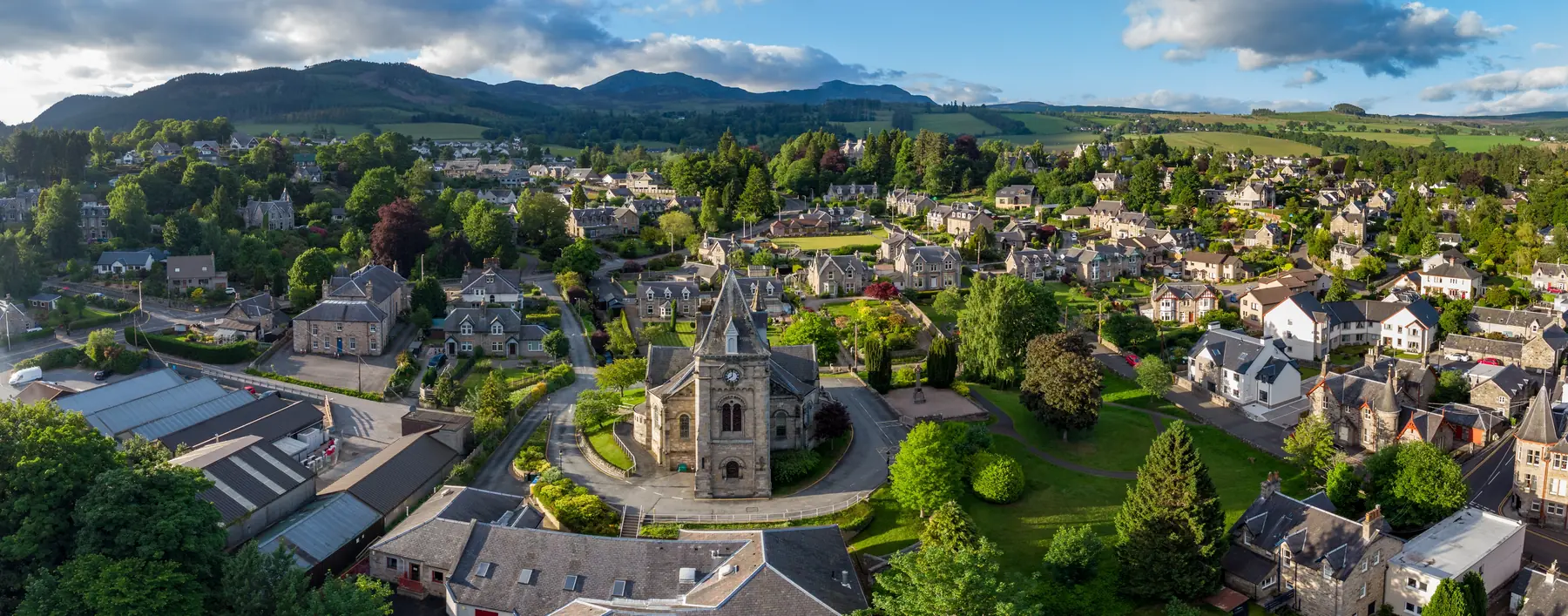
Pitlochry is one of the best walking bases in Scotland for people who do not want to climb a mountain — and it has a mountain for those who do. The town sits in the Tummel valley with forest on every side, a loch immediately behind it, three gorges and a set of waterfalls within a short drive, and Ben Vrackie rising directly above.
Almost all of it is waymarked, most of it is under trees, and a good deal of it starts from the middle of the town. Highland Perthshire is marketed as Big Tree Country and the label is earned.
Distances are from the town centre.
The classic Pitlochry walk, and you can start it from the high street. Loch Faskally was created in the 1950s when the dam was built for the hydro-electric scheme, and the circuit around it is about eight kilometres of almost entirely level path through mixed woodland, crossing the river twice.
On the way you pass the dam and fish ladder, the Festival Theatre, the suspension bridge at Port-na-Craig, and Faskally Forest on the northern shore. Two to three hours at a stroll, and it is genuinely lovely at any time of year — spectacular in October.
Beside the dam, eight hundred metres from the centre. A series of thirty-four linked pools that let salmon climb past the dam to spawn upstream, with an underwater viewing chamber. The fish run mainly from spring through autumn and there is a counter showing how many have gone up. It takes twenty minutes and it is free. See our fish ladder page.
Two kilometres south-east, reached by a path through woodland from the edge of the town or from the Edradour road. A waterfall dropping around sixty metres in a wooded gorge, with a viewing platform. Under an hour round trip and much less visited than it deserves.
Two kilometres south, a Pictish cross-slab of the eighth or ninth century standing under a canopy in a field, carved on both faces. Free, open and almost always empty.
The hill above the town, 841 metres, and the reason a lot of people come here. The path starts from the village of Moulin, just north of Pitlochry, and climbs steadily past a small loch to a rocky summit with a view over the Tummel and Tay valleys, north to the Cairngorms and south to the Lowlands.
Four to five hours round trip, with a proper climb and a rocky final section. It is not a technical hill but it is a real one — take boots, a forecast and warm layers.
A smaller wooded hill north-west of the town, National Trust for Scotland, with a viewpoint over the Tummel valley and the Loch Tummel gap. Two hours round trip from the golf course, on forest tracks.
Five kilometres north. The Pass of Killiecrankie is a wooded gorge where the Garry runs through a narrow rock channel, and it was the site of a battle in 1689 in which a Jacobite army defeated a government force. Soldier’s Leap is the point where a fleeing government soldier is said to have jumped the river — a gap that looks impossible until you stand at it.
There is a National Trust for Scotland visitor point, a path down into the gorge, and the Garry Bridge above with a bungee jump operating from it. The walk from Killiecrankie down the gorge to the Linn of Tummel and back into Pitlochry is about ten kilometres and is the best full-day walk from the town.
Three and a half kilometres north-west, where the Tummel and the Garry meet in a set of rapids and pools among old woodland. National Trust for Scotland, free, with a chain bridge and paths on both banks.
Fifteen kilometres north, near Blair Atholl. A series of waterfalls in a rocky gorge with paths and bridges climbing beside them. They have been a tourist attraction since the eighteenth century, and the surrounding woodland exists because Robert Burns wrote a poem in the voice of the Bruar Water asking the Duke of Atholl to plant trees along its banks — and the Duke did.
The lower falls are a twenty-minute walk from the car park; the full circuit to the upper falls takes about an hour and a half. See our Falls of Bruar page.
Eighteen kilometres south at Dunkeld. Ossian’s Hall, an eighteenth-century folly, stands directly above the Black Linn Waterfall on the River Braan, with windows positioned so that the fall fills them. Around it grow some of the tallest trees in Britain — Douglas firs of well over sixty metres. National Trust for Scotland.
It is the single most popular short walk in Perthshire, and it deserves to be.
Faskally Forest, on the loch shore, is the town’s own wood and is famous for its autumn colour — it is where the Enchanted Forest light show is staged in October.
Tay Forest Park, a network of Forestry and Land Scotland woodlands spread across highland Perthshire, has waymarked trails at Allean, Queen’s View above Loch Tummel, and Craigvinean near Dunkeld. See our Tay Forest Park page.
Queen’s View, fourteen kilometres west, is the classic photograph of Loch Tummel with Schiehallion beyond, with a visitor centre and short walks.
Season. October is the reason many people come — the birch and larch of highland Perthshire turn as well as anywhere in Britain. Our autumn guide covers where and when.
Ticks are present in bracken and long grass from spring to autumn.
Buses run north to Killiecrankie and Blair Atholl, and south to Dunkeld and Perth, which makes linear walks straightforward.
Parking. There are car parks at Killiecrankie, the Linn of Tummel, Bruar, the Hermitage and Queen’s View; some charge.
Ben Vrackie is a mountain, not a hill walk. Check the forecast.
Spring comes late and slowly. The birch greens in May, the gorse is out on the hillsides, and the waterfalls run with snowmelt from the Cairngorms. The paths are quiet.
Summer is when the woods are at their thickest and the midges arrive — worst near water and in still weather from June to September. It is also when the Festival Theatre runs its main season and the town is busiest.
Autumn is the reason a great many people come, and it deserves its reputation. Highland Perthshire’s mixture of native birch and planted larch, beech and Douglas fir produces one of the best displays in Europe, running from late September into early November. Our autumn guide covers where and when.
Winter empties the paths and gives the clearest air of the year. Ben Vrackie in snow is a genuine winter hill requiring proper equipment; the loch circuit and the gorge paths are simply beautiful.
Highland Perthshire is a strong area for it. Red squirrels are common in Faskally and the surrounding woods — this is one of their British strongholds. Red deer are on the hills and come down into the woods in hard weather; the autumn rut, from late September, is audible across the glens. Ospreys fish the lochs in summer. Red kites and buzzards are frequent over the valley, and golden eagles are possible on the higher ground.
And in the river, the salmon — the Tay system is the most famous salmon fishery in Britain, and the fish ladder at Pitlochry lets you watch them making the climb.
The Loch Faskally circuit for an easy half day; Ben Vrackie if you want a summit; Killiecrankie for the gorge and the history.
Four to five hours round trip from Moulin, with a steady climb and a rocky final section.
Yes, and it takes twenty minutes. There is an underwater viewing chamber and a counter showing the salmon run.
The Loch Faskally circuit, the Linn of Tummel and most of the Tay Forest Park trails are level or nearly so.
The Falls of Bruar for scale, the Black Spout for a short walk from town, and Black Linn at the Hermitage for the folly above it.