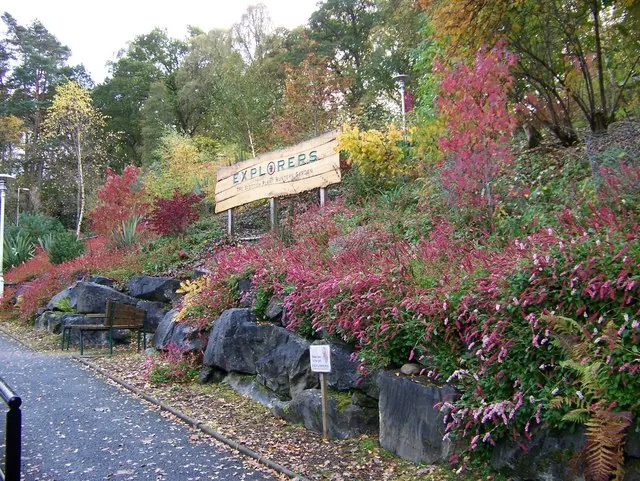
The Explorers Garden occupies six acres of hillside beside Pitlochry Festival Theatre, on the south bank of the River Tummel at Port-na-Craig, and it has a specific and unusual subject.
It celebrates the Scottish plant hunters — the collectors who, between the eighteenth and twentieth centuries, travelled to the Americas, the Himalaya, China and the Pacific and sent home the plants that transformed European gardens.
It does this the right way: by growing what they found, in areas arranged by region of origin.
A disproportionate number of the great collectors were Scots, and the garden makes the case.
David Douglas (1799–1834), born at Scone near Perth, who introduced the Douglas fir, the sitka spruce, the lupin and around 240 other species to Britain — and who died in Hawaii at 35, gored by a bull in a pit trap.
Archibald Menzies, ship’s surgeon and naturalist on Vancouver’s voyage, who brought back the monkey puzzle — reputedly by pocketing seeds served to him at a dinner in Chile.
Robert Fortune, who smuggled tea plants and the knowledge of tea processing out of China for the East India Company.
George Forrest, who made seven expeditions to Yunnan and introduced hundreds of rhododendrons and primulas.
Francis Masson, John Jeffrey, William Jameson and others.
The garden’s regional sections — North America, China, Japan, the Himalaya, South America, Tasmania and New Zealand — let you see what each of them found.
A trail climbing gradually up the hillside, with the theatre and the river below and views across the water to Pitlochry.
Plenty of benches and a couple of covered shelters, which given Perthshire weather are useful.
Garden-related artwork and sculpture through the planting, including a Wooden Chinese Pavilion and carved pieces.
A huge variety of plants, and the reason to come more than once is that the seasons change it completely: rhododendrons and meconopsis in late spring, the North American section in summer, and strong autumn colour.
The garden is maintained largely by volunteers, and it shows in both directions.
The planting is knowledgeable and the collection is genuinely interesting. It is also, by the report of several visitors, somewhat unkempt in places and in need of weeding — this is not Bodnant or the Royal Botanic Garden, and it does not have the staff for that standard.
Whether that matters depends on what you want. If you want immaculate horticulture, it will disappoint. If you want an interesting collection with a story attached, in a fine position, for a modest ticket, it is very good indeed.
Pitlochry Festival Theatre is the other half of the site and is one of the most remarkable cultural institutions in rural Britain: a full producing repertory theatre running a summer season of several plays in repertoire, plus a year-round programme.
The festival has run since 1951 — for its first thirty years in a marquee, and since 1981 in the present building by the river. The summer season runs June to September, with plays alternating so that a visitor staying a few days can see three or four different productions.
There is a restaurant and café at the theatre with a riverside terrace.
Admission charged, modest.
Time: an hour to ninety minutes.
Season: roughly April to October.
Access: the trail climbs the hillside on paths with slopes and some steps; the lower sections are more manageable.
Facilities: the theatre’s café, restaurant and toilets are alongside.
Getting there: Port-na-Craig, across the suspension footbridge from Pitlochry town centre — a ten-minute walk — or by road with parking at the theatre.
The Scottish plant hunters, with the garden arranged by the regions they collected from — North America, China, the Himalaya, Japan, South America and Australasia.
Six acres on a hillside above the River Tummel.
It is volunteer-maintained and the planting is knowledgeable, but visitors note it can be unkempt in places. It is a collection rather than a showpiece garden.
An hour to ninety minutes.
Pitlochry Festival Theatre, a producing repertory theatre running a summer season of plays in repertoire since 1951.