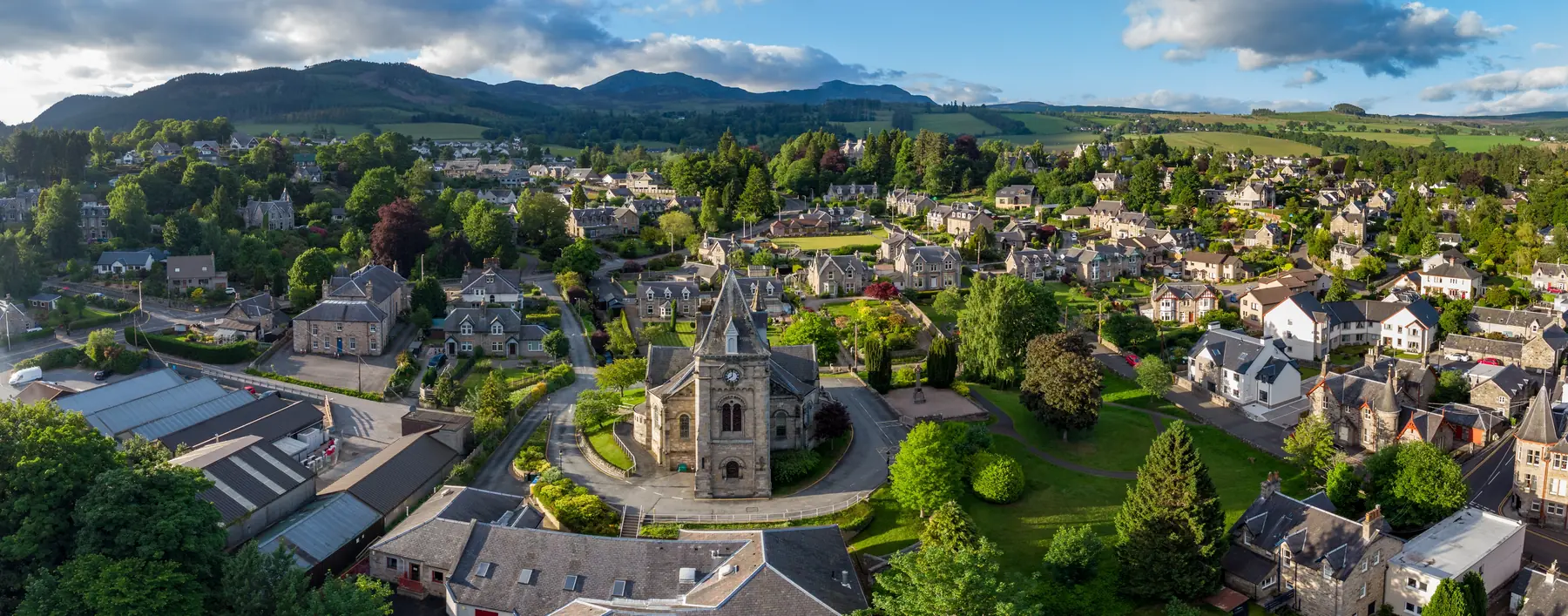
Highland Perthshire is wet — it sits where the Atlantic weather meets the first serious hills — and Pitlochry has spent a hundred and sixty years working out what to do about it. The town became a resort in the Victorian era, and the things Victorians built for bad weather are still here: a theatre, hotels with big lounges, a covered high street of shops, and two whisky distilleries.
Add a castle with thirty rooms open ten kilometres up the road, and a wet day here is not a problem.
The obvious answer, and Pitlochry has two distilleries within a couple of kilometres of the high street.
Blair Athol Distillery, on the southern edge of the town, is one of the oldest working distilleries in Scotland and the spiritual home of a very well-known blend. Tours run through the day, there is a visitor centre and shop, and the buildings are handsome.
Edradour, three kilometres east up a single-track road, is one of the smallest distilleries in Scotland — a whitewashed farm-scale operation with equipment barely larger than the legal minimum, still run on a very small scale. It is a completely different experience from a large distillery and worth doing for the contrast.
Between them they will absorb most of a wet day. Our whisky guide has the detail.
Ten kilometres north at Blair Atholl. More than thirty rooms open to the public — a ballroom hung with antlers, a great collection of arms and armour, portraits, furniture and tapestry — plus a restaurant and shop. It is the seat of the Dukes of Atholl, whose private army, the Atholl Highlanders, is the only one left in Europe.
It is entirely indoors apart from the walk from the car park, and it takes two to three hours. The best single wet-weather visit in the area.
Pitlochry Festival Theatre, on the far bank of the Tummel below the town, has been running since 1951 and produces a full summer season in repertoire plus a winter programme — a serious producing theatre in a village of three thousand people, which is unusual anywhere.
A matinee is the most civilised possible answer to a wet Pitlochry afternoon. There is a good café and the Explorers Garden attached, and the walk over the suspension bridge to it is short.
The Atholl Palace Museum, in the grounds of the big Victorian hotel above the town, covers the history of Pitlochry as a resort, the hotel’s use as a wartime school and the coming of the railway. Small, cheap and rather charming.
Pitlochry and Moulin Heritage Centre on Atholl Road does the same job in the middle of town.
Atholl Country Life Museum at Blair Atholl covers crofting and village life in the old school building.
Iain Burnett, the Highland Chocolatier at Grandtully, six kilometres west, makes truffles on the premises with a viewing window into the kitchen, runs tastings and has a café. It is a very good wet ninety minutes.
Pitlochry’s Atholl Road is a Victorian high street of woollen shops, outdoor retailers, galleries, bookshops and cafés, largely intact because the A9 was diverted onto a bypass in 1981 and later development passed the town by. It is a genuinely pleasant street to potter along in poor weather.
Highland Perthshire is Big Tree Country, and tree cover changes everything.
Faskally Forest and the Loch Faskally circuit are largely under mixed woodland and the paths drain well.
The Falls of Bruar and the Black Spout both need rain to be at their best — a waterfall in spate is worth going out for.
The Hermitage at Dunkeld is the definitive wet-weather walk in Perthshire: a short path through enormous Douglas firs to a folly built directly over a waterfall, with the fall framed in the windows. Better in rain than in sunshine.
Killiecrankie and the Linn of Tummel are both wooded gorges and both improve with water in them.
Avoid Ben Vrackie in low cloud — it is a mountain and the summit is rocky and exposed.
The rivers here are the point. Nae Limits at Logierait and the operators around Grandtully run white water rafting, canyoning, river tubing and cliff jumping on the Tay and the Tummel, and all of it is better when the rivers are up. Rain is an asset rather than an obstacle.
Perth, forty-five kilometres south, has museums, Scone Palace and covered shopping — the obvious escape if it has genuinely set in.
Dundee, an hour east, has the V&A Dundee on the waterfront and Discovery Point.
Dunkeld, eighteen kilometres south, has a ruined cathedral on the Tay, a National Trust street of restored houses and the Hermitage.
Trains run to Perth, Edinburgh, Glasgow and Inverness every hour or two from a station in the middle of the village, which makes a wet-day escape simple.
Check the mountain forecast separately if you were planning Ben Vrackie; cloud base is the number that matters.
Seasonal closing. Blair Castle, the theatre’s main season and several attractions run to a season. Check before travelling in winter.
Drying rooms are standard in Pitlochry’s hotels and guesthouses, which have been housing wet walkers since the 1860s.
The shape that works: Blair Athol Distillery in the morning, which is a kilometre from the high street and covers ninety minutes indoors. Lunch on Atholl Road. Then either the Festival Theatre for a matinee, or the drive north to Blair Castle for the afternoon, which is thirty rooms and two to three hours under a roof. Finish with the Falls of Bruar on the way back, because a waterfall in spate is worth getting wet for.
If the weather is set in for the week, the trains to Perth and Dundee are the escape — Scone Palace, the museums and the V&A on the Dundee waterfront are all an hour or less away.
Pitlochry sits at 100 metres or so in a valley, with hills to 841 metres immediately above it and the Cairngorms an hour north. The valley floor is the mildest and driest; Ben Vrackie’s summit can be in full winter conditions while the town is merely damp.
Cloud base is the number to look at. Below 600 metres and the hills are pointless but the gorges and the woods are fine — which describes a large proportion of Highland Perthshire days and is not a reason to stay indoors.
Pitlochry’s Victorian high street is unusually good for this. Atholl Road runs the length of the town with woollen shops, outdoor retailers, galleries, bookshops and a run of cafés and hotel lounges, most of them entirely happy for you to sit for an hour.
The Festival Theatre café, across the suspension bridge, is the pleasantest spot in bad weather — glass-fronted, warm, looking over the river — and you do not need a ticket to use it.
Two distilleries in the town, Blair Castle ten kilometres north, a matinee at the Festival Theatre, and the Highland Chocolatier at Grandtully.
Blair Athol for the classic distillery tour; Edradour for one of the smallest distilleries in Scotland and a completely different scale.
Yes — more than thirty rooms, plus a restaurant and shop. It is the best wet-weather visit in the area.
Considerably. The Falls of Bruar, the Black Spout and Black Linn at the Hermitage all need water to be worth the walk.
There is a summer season in repertoire and a winter programme; check what is on before planning around it.