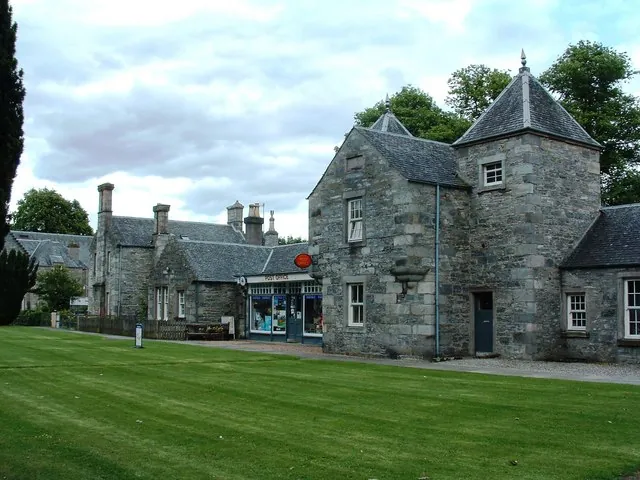
Blair Atholl is a village in Perthshire built about the confluence of the Rivers Tilt and Garry, on one of the few pieces of flat land in the middle of the Grampian Mountains. The name records that: blàr is Gaelic for ‘field, plain’, and Atholl — from the archaic Ath Fhodla, ‘new Ireland’ — is the surrounding district.
You go for Blair Castle, and the castle is why the village looks as it does. Until the early 19th century the only building on the site was Blair Atholl Mill; the settlement then grew as a largely planned village around the parish church, after that church had been moved down from Old Blair, the older hamlet still standing inside the castle grounds. The estate came first; the village was laid out below it afterwards.
The straight-line distance from Pitlochry is 9.6 km. The village has been inside the Cairngorms National Park since 13 March 2008, a change made at the request of the people of the town.
Blair Castle was the traditional home of the Earls, later Marquesses, now Dukes of Atholl, and it was the last castle in the British Isles to be besieged, in 1746 during the last Jacobite rising. Afterwards its upper storey and battlements were taken off to render it indefensible; when a medieval appearance came back into fashion in the 19th century the building, by then known as Atholl House, was raised in height and battlemented again, with white harling hiding most of the joins. The oldest part, Comyn’s Tower, has immensely thick walls and is claimed — perhaps dubiously, — to date from the 13th century; the majority is 16th century, much altered.
Two things make it unusual. Thirty-two rooms are open to the public, more than in any comparable stately home, and what fills them — furniture, paintings, weapons, embroidery, Highland artefacts, hunting trophies — is among the finest in Scotland, as is the plasterwork of the principal rooms. Second, the Duke of Atholl is the only person in the United Kingdom allowed to raise a private army: the Atholl Highlanders, now largely social and ceremonial, drawn mainly from people who work on the estate. The castle no longer belongs directly to the Duke — the 10th left it in trust on his death in 1996, and the 11th, who lived in South Africa, came over once a year to review them.
It carries 4.7 from 3,649 Google reviews, and the recurring note is that people underestimate it. A visitor in August 2026 wrote, “It is so much bigger than we anticipated and full of things to do,” adding that “You can bring your own packed lunch as there are picnic benches outside.” Catering is where reviewers part company: one in September 2024 was blunt, “The restaurant wasn’t great, food reminded me of school dinners.”
The Dukes altered and added to the grounds over several centuries. Diana’s Grove and the Hercules Garden, both laid out in the first half of the 18th century, are rare examples of their period, each adorned with lead reproductions of Classical statues. The Dukes were early and enthusiastic tree planters, and Diana’s Grove contains some of the tallest trees in Great Britain; the Hercules Garden, restored recently, is a walled formal garden with an artificial lake and islands, ringed by plantations of fruit trees.
Old Blair, in the grounds, holds the older story: in the Middle Ages the main road from Atholl to Badenoch, and so to the north of Scotland, ran through it and over the Minigaig Pass. Its church, dedicated to St Bride and probably an early Christian site, is roofless now; John Graham of Claverhouse, Viscount Dundee — ‘Bonnie Dundee’ — was buried in the aisle attached to it after the Battle of Killiecrankie on 27 July 1689, and the Dukes’ modern railed burial enclosure adjoins the ancient unenclosed churchyard.
Atholl Estates Office, 4.6 from 378 Google reviews, arranges stalking on the hill; a visitor in July 2026 wrote, “We started at 5 a.m., hiking through the foggy hills with Reuben on the estate.” The grounds also hold the Blair Atholl Patrol Jamborette, run every two years since 1946 and Scotland’s largest regular Scout camp, with about 1,200 participants, half Scottish and half international.
The village itself is small. Blair Atholl Watermill, a bakery at 4.8 from 370 Google reviews, is the eating place reviewers keep naming; a visitor in June 2026 wrote, “Very busy at lunch today, but sufficient staff who were friendly and very helpful.” The Atholl Arms Hotel began in 1820 as a private hunting lodge built by the 4th Duke.
The Atholl Country Life Museum, in the old school, covers the social history of the area; it opens in summer and there is an entrance charge. At 4.3 from 35 Google reviews it has the lowest rating and smallest sample of anything here — a village museum, not a poor one.
Blair Castle Caravan Park sits in the castle grounds, 4.6 from 893 Google reviews; a visitor in July 2026 wrote that “the River Tilt is crystal clear and good for a paddle in the safe spots this time of year.”
One local oddity: an unusual legal agreement of 1911, made for the benefit of steam trains, left responsibility for the village’s public water supply with whichever railway company owns the line through it — currently Network Rail, which announced in April 2006 that it would finance connecting Blair Atholl and Bridge of Tilt to Scottish Water.
The train is the natural way. Blair Atholl has its own station on the Highland Main Line, the line Pitlochry also stands on; services run roughly every hour or two from Edinburgh and Glasgow via Perth, continuing north through Blair Atholl to Kingussie, Aviemore and Inverness. Pitlochry’s station is 0.3 km from its town centre.
The A9 from Perth to Inverness ran through the village until it was bypassed in 1984. By bike, komoot documents a 67 km Loch Tummel and Blair Atholl loop, rated difficult; Blair Atholl Bike Hire operates from Blair Castle Caravan Park, beside the Atholl Estates off-road network and 9.7 km straight-line from the Pitlochry centre. Bikes travel free on Scottish trains, but the Perth-to-Inverness section requires a cycle reservation, so book the bike space with the ticket.
The pack establishes no bus service between Pitlochry and Blair Atholl.
The village and what is around it, at walking scale.
Open any of them in Google Maps for directions and current opening.
Attractions, prices and availability in Pitlochry
These come from GetYourGuide's booking widget, which sets their cookies in your browser. Consent to load it and see the attractions and prices.
Background on Blair Atholl draws on its Wikipedia article, text there being available under CC BY-SA 4.0.