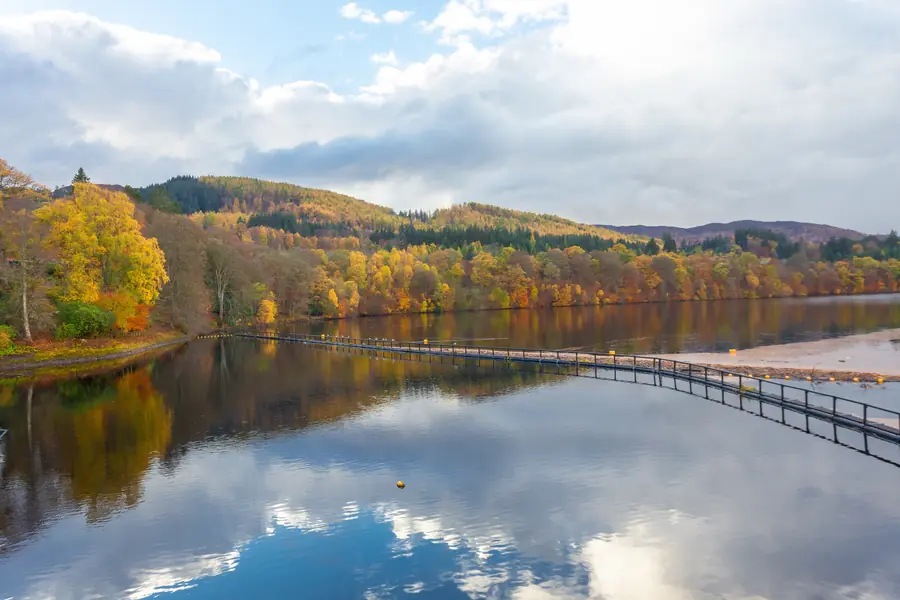
Faskally Wood lies two kilometres north of Pitlochry, and it is the town’s own forest — close enough to walk to, and the place most visitors end up on an afternoon without a plan.
It was laid out in the nineteenth century as a model woodland by Archibald Edward Butter of Faskally, who planted a wide mixture of species as an ornamental and experimental estate rather than a commercial plantation. That is why the wood is what it is: mixed broadleaf and conifer, planted for effect.
In 1953 the Forestry Commission bought it and set up a training school for young foresters here, and it is now part of Tay Forest Park.
Faskally is famous for its autumn colour, and the reason is the Victorian planting: beech, oak, birch, larch, and a wide range of introduced species turning at different times over several weeks.
Mid-October is normally the peak. Perthshire markets itself as Big Tree Country and this is one of the reasons.
The Red Trail — about three-quarters of a mile, surfaced and accessible, the easy option.
The White Trail — about a mile and a half, steep in places and not suitable for wheelchairs.
Loch Dunmore circuit — the best half-hour in the wood. A small loch with a floating pavilion on it, reached by a wooden bridge, surrounded by trees and water lilies. It is a genuinely lovely thing and it photographs itself.
The lily pond, the River Tummel shore, and a route out to Loch Faskally and the dam.
Longer routes link into the wider Tay Forest Park and to Pitlochry itself along the loch shore.
Cycling: possible on the main tracks but the loch circuit has steps in places and is not really a bike route. Visitors who take bikes report having to carry them.
For about five weeks from early October to early November, Faskally hosts The Enchanted Forest — a large sound and light installation through the trees, ticketed and separately organised, which is one of Scotland’s biggest autumn events.
It uses the wood at night, and when it is running the daytime access arrangements change. Check before visiting in October.
Faskally is not part of the Forestry and Land Scotland night-access scheme at other times.
Free to walk; parking is charged, paid through the RingGo app.
Time: half an hour to a half day.
Facilities: toilets at the car park; no café. Pitlochry is five minutes away.
Access: the Red Trail is surfaced and accessible; the White Trail and the Loch Dunmore circuit are not throughout.
Dogs: welcome under control.
Getting there: two kilometres north of Pitlochry off the B8019, five minutes by car, or about forty minutes’ walk from the town along the loch.
Loch Faskally, the reservoir created by the Pitlochry dam, with a path all the way round — about 12 kilometres, and the best long walk from the town.
The Pitlochry Fish Ladder and the dam are at the southern end.
The Linn of Tummel is a short distance north.
The Pass of Killiecrankie is five minutes further.
Usually mid-October, thanks to the Victorian mixed planting.
The accessible Red Trail is about three-quarters of a mile; the White Trail is a mile and a half and steeper. The Loch Dunmore circuit takes about half an hour.
A small floating pavilion on Loch Dunmore, reached by a wooden bridge — the wood’s most photographed feature.
Yes, and it is paid through the RingGo app rather than at a machine, so have the app and a signal before you arrive.
On the main tracks, yes, but parts of the Loch Dunmore circuit have steps and are not really suitable.