Dunkeld is a town of 1,194 people, counted in 2022, on the north bank of the River Tay opposite Birnam. The name is the Gaelic Dùn Chailleann, “fort of the Caledonians”, for the hill fort on King’s Seat just north of the town. It sits close to the Highland Boundary Fault, on the main road and rail lines north, which is why it is frequently described as the “Gateway to the Highlands”.
The straight-line distance from Pitlochry is 18.0 km.
You go because almost all of the town was destroyed on a single day in August 1689 and then built again. The cathedral survived in part and still stands in two conditions, a roofless nave beside a working parish church. The streets around it are the replacement, largely intact. Across the A9 to the west is the other draw, a wooded gorge on the River Braan with a folly above the waterfall. Dunkeld itself is listed as an attraction at 4.7 from 148 Google reviews.
Kenneth I is reputed to have brought relics of St Columba here from Iona in 849, to keep them from Viking raids, building a new church over a Pictish monastery. The Danes came anyway, sailing up the Tay to raid it in 903, and for a time this was the chief ecclesiastical site of eastern Scotland.
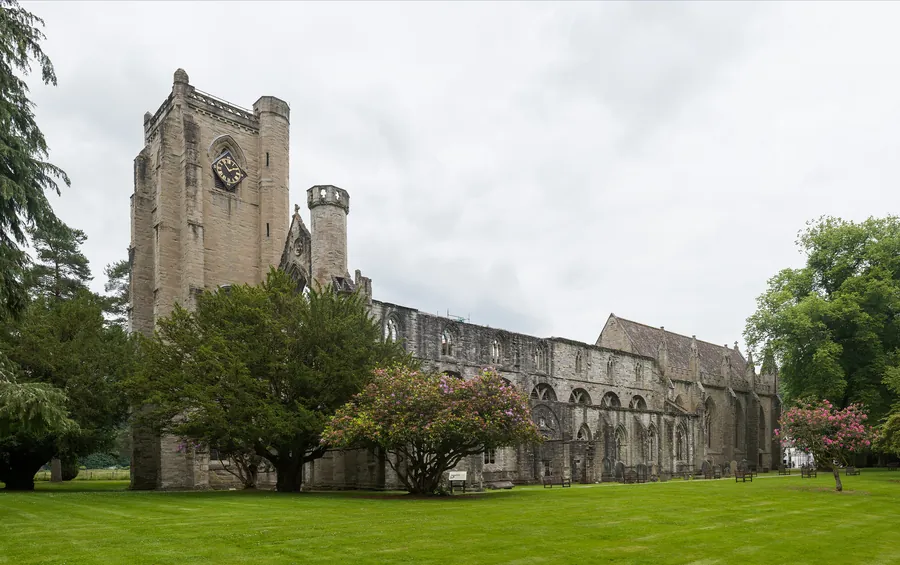
The building is medieval and in two states. The unaisled choir, of the 13th and 14th centuries, is still the parish church. The aisled nave went up from the early 15th century and has been roofless since the early 17th; the tower, south porch and chapter house were added between 1450 and 1475. Nave, porch and tower are in the care of Historic Environment Scotland.
Below the vault of the tower’s ground floor, the medieval Bishop’s Court, are remnants of pre-Reformation murals of biblical scenes from about 1490, among very few such survivals in Scotland; the clearest is a Judgement of Solomon. The museum in the former chapter house, a burial aisle of the Dukes of Atholl after the Reformation, holds the Apostles’ Stone, a badly worn cross-slab.
On 21 August 1689 the 26th Foot, the Cameronian Regiment, under Lieutenant William Cleland, fought off the Jacobites here shortly after their victory at Killiecrankie. Cleland died in the clash, most of the town was destroyed, and musket-ball holes from the fighting can still be seen in the cathedral’s east gable.
What replaced it is one of the most complete 18th-century country towns in Scotland, around twenty of its harled houses restored by the National Trust for Scotland. The older part is a Y parallel to the Tay: Brae Street and High Street slope down from the east into the long V of the market place called The Cross, with closes leading off to the backlands behind the houses. On the site of the old mercat cross stands the neo-Gothic Atholl Memorial Fountain of 1866, heavy with heraldry and Masonic symbolism, and at the west end is the Ell Shop of 1757, named for the iron weaver’s measure fixed against one corner.
In 1809 Thomas Telford’s stone bridge over the Tay went up at the east end, financed by the 4th Duke of Atholl, and a new street was laid at right angles to the old alignment.
The Hermitage, on the western side of the A9, is National Trust for Scotland countryside: wooded walks along the River Braan, with the folly called Ossian’s Hall of Mirrors above the falls. It is the busiest thing in the area, at 4.8 from 4,226 Google reviews, with Black Linn Waterfall at 4.9 from 83.
Parking is charged. A visitor in July 2026 wrote, “It’s Paid parking. We did around a 10k walk”, and added that “Once we got about 2k in there were very few other people too” — the crowding is at the car park end. The recurring complaint is not the site but its users: the same July 2026 review objected to “bags of dog crap littered round”.
This is country marketed as Big Tree Country. The Birnam Oak, 4.7 from 400 Google reviews, is believed to be the only surviving tree of the Birnam Wood in Macbeth; a visitor in June 2026 wrote, “Interesting history and I love the fact that you can get inside the hollow trunk.”
Loch of the Lowes, about 2 miles (3 kilometres) north-east, is a Scottish Wildlife Trust reserve at 4.6 from 723 Google reviews, and the nesting ospreys are what most people come for. Reviewers are warm about the walk and blunt about the facilities: a visitor in July 2026 wrote, “The centre is a bit run down but it serves the purpose. You can watch the birds but don’t come here expecting a lunch and cakes.”
Across Telford’s bridge, Birnam Hill rises to 1,324 feet (404 m) a mile (2 km) south of the railway station. Birnam Arts and the Beatrix Potter Perthshire Experience carries 4.5 from 665 Google reviews, but the pack’s recent ones are middling: a visitor in June 2026 called it a “Tiny garden with a few statues of Beatrix potter caricatures.”
The train is the straightforward option. Dunkeld and Birnam station is on the Highland Main Line between Perth and Inverness, the same line Pitlochry sits on, with services roughly every hour or two from Edinburgh and Glasgow via Perth. The pack puts it 19.0 km from Pitlochry centre, at 4.3 from 26 Google reviews. Its address is Birnam Glen, on the far bank, so arriving by rail means crossing Telford’s bridge on foot.
By road, the A9 was rerouted past Dunkeld in 1977 and now runs west of the town rather than through it. Regular bus and coach services run to Birnam and Dunkeld along that road, with long-distance coaches run by Scottish Citylink. The pack establishes no timetabled local bus between the two, so check before planning around one. For drivers, the North Car Park on Atholl Street rates 4.3 from 137 Google reviews.
By bike, the pack describes a Dunkeld-to-Pitlochry loop leaving Pitlochry on National Cycle Network Route 7 and joining Route 77 after a well-preserved railway viaduct. Bikes travel free on Scottish trains, but the Perth to Inverness section needs a cycle reservation booked with the ticket.
The village and what is around it, at walking scale.
Open any of them in Google Maps for directions and current opening.
Attractions, prices and availability in Pitlochry
These come from GetYourGuide's booking widget, which sets their cookies in your browser. Consent to load it and see the attractions and prices.
Background on Dunkeld draws on its Wikipedia article, text there being available under CC BY-SA 4.0.