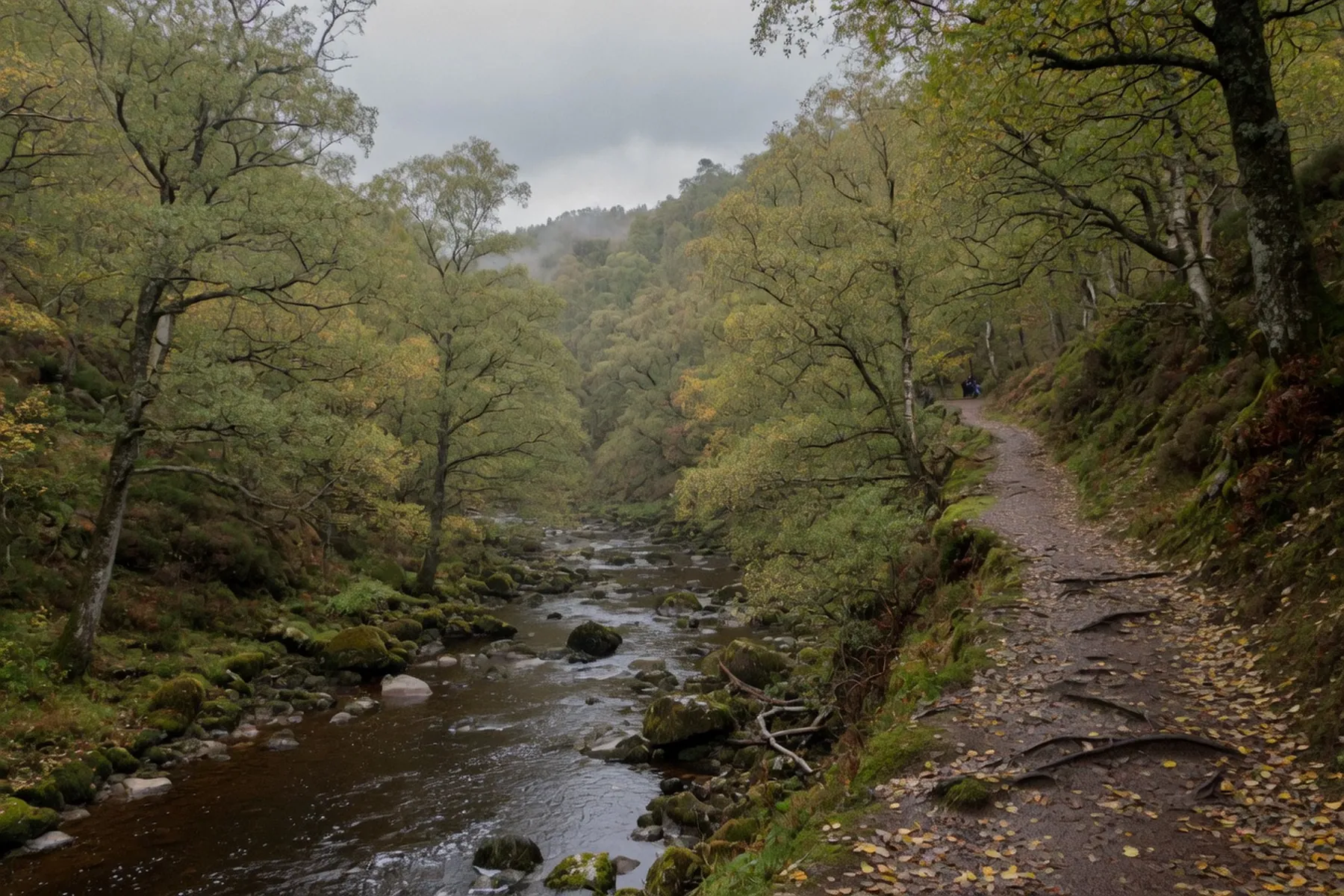
The National Trust for Scotland puts Killiecrankie three miles north of Pitlochry. You leave on the old road, the B8079, not the A9. What you come for sits in one stretch of the River Garry: a wooded gorge, a battle fought on the slope above it in 1689, a rock gap the Trust still calls Soldiers Leap, and, from the road bridge downstream, a bungee rope.
The gorge is free. The car park is not. The Leap itself is a short, steep drop from the visitor centre. The day is the path beyond it.
The Trust times the walk from the visitor-centre car park to Soldier’s Leap at about 15 minutes. You follow the veranda past the bird feeders, go down a flight of steps, cross a wooden footbridge, and drop through oak wood on more steps. The Trust’s own access note is the one to believe: the visitor centre, café and toilets are on one level; the footpath into the Pass is steep, uneven and has steps. Disabled parking sits on both levels of the car park. Anyone who cannot manage the descent can stay on the balcony.
The Leap is the point where a government soldier, Donald McBane, is said to have jumped the Garry while fleeing the Jacobites on the evening of 27 July 1689. The Trust still writes 18ft. Historic Environment Scotland, in the Inventory of Historic Battlefields, calls it “an improbable jump of around 5 m across the rapids of the River Garry”. McBane published his own version in 1728: he laid down his gun and his hat, jumped, and lost a shoe. There is a small waterfall. Do not try it.
The battlefield is not the gorge. The Trust puts it about a mile north of the visitor centre, on the southern slopes of Creag Eallaich. Historic Environment Scotland designated it BTL12 in 2011. The A9 now cuts across the ground the Highlanders charged over.
That evening John Graham of Claverhouse, Viscount Dundee, had about 2,400 Jacobites on the high ground. Major-General Hugh Mackay was coming up the Pass with between 3,500 and 5,000 government troops. Dundee waited until the sun was out of his men’s eyes. Around 8 pm the charge came down in three bodies. On the government left, Mackay’s men got off no more than three volleys before the line broke. Historic Environment Scotland records that the main action took less than an hour. Summaries that put the fight at three minutes, or ten, are compressing a messy evening into a slogan.
HES puts Jacobite losses at 600–800 and government losses at around 2,000. Dundee was shot leading the small Jacobite cavalry. Without him the rising lost its commander and was finished within a year. The visitor centre has weapons from the field and handling replicas. On the gorge path you pass Trooper’s Den, where the Trust says the first shot is believed to have been fired, and the stone that marks Brigadier Barthold Balfour, killed in the rout. Soldier’s Leap is the line of the government retreat, not the core of the fighting.
The site and the visitor centre are free. The car park is charged. On 10 September 2026 the Trust’s live price box listed £5; an older sentence on the same planning page still said £4. Members of the National Trust and the National Trust for Scotland park free. Read the machine, or the Killiecrankie planning page, before you assume a figure copied from a blog.
The building is open daily except Christmas Day, Boxing Day and New Year’s Day. Trust hours on that page: 1 April–25 October, 10.00–17.00; 26 October–31 March 2027, 10.00–16.00. The café is independently run — eatatkilliecrankie.co.uk — and publishes the same seasonal split, 10–5 in the summer window, 10–4 from November to March. Confirm before you count on a late lunch in October.
Dogs are welcome on site and in the building, on a lead indoors. Toilets are on the Perth and Kinross Comfort Scheme. The Trust is explicit about fires: none, and no barbecues, at any time of year.
The Trust’s own Pass walk is 2½ miles (4 km) there and back, 1½ hours, 81 m of ascent, graded moderate, starting and finishing at the visitor centre. After the Leap you can continue to the green footbridge — allow about 30 minutes from the Leap. That bridge is the view, especially once the oak and birch have turned. From there you can go back the way you came, take the roadside return (worse), cross into the Linn of Tummel, or stay on the left bank toward Pitlochry, which the Trust times at approximately 3 miles.
The steps down to the river are irregular and uneven. After rain they are greasy. Boots, not trainers. The Victorian railway viaduct sits on the riverside path. Further on, the charcoal kiln is working conservation rather than a reconstructed camp: the Pass is a Site of Special Scientific Interest for its oakwood, beech is crowding the oak, and the Trust sells the charcoal from the visitor centre.
Linn of Tummel (National Trust for Scotland) is 2½ miles north-west of Pitlochry on the B8019, or about 1½ miles from Killiecrankie along the old military road, on the Trust’s own figures. Open all year, free. Parking is at Garry Bridge; access to the path is by steps. The path is uneven, with slopes, narrow sections and steep river banks. There is livestock. Dogs need to be under close control. The Trust’s circular here is 3 miles. Queen Victoria’s 1844 visit is marked by an obelisk.
From the green footbridge you can also stay on the Pitlochry side and walk the Garry, then the Tummel, into Faskally Forest and the loch. That is the linear walk the without a car piece already points at, and it is the honest way to make the parking charge at Killiecrankie worth it: ride the bus one way. The walks guide maps the rest of the network.
The hill alternative is the Bealach path from town via Moulin. Walkhighlands publishes 16 km / 10 miles, about 5 hours, starting at Rie-Achan. That is a different day from the gorge.
Highland Fling Bungee operates from a purpose-built platform under Garry Bridge: 40 m over the Garry, on the operator’s own figures. Check-in is at the Killiecrankie visitor centre. They run year-round. Minimum age 14; the current activity page gives a solo weight band of 35–140 kg. There is a swing from the same bridge and Killie Zip through the trees. Spectators are welcome. Prices move — the activity page and the FAQ on the same site currently disagree — so book on bungeejumpscotland.co.uk and ignore copied figures.
You do not have to jump. The bridge is on the walk, and the Trust’s Linn circular uses it as a viewpoint.
Drive: A9 north, Killiecrankie signs, then the B8079. The Trust’s postcode is PH16 5LQ; the café uses PH16 5LG. Coach parking is listed. If you are combining the gorge with Blair Castle & Gardens, the same old road continues to Blair Atholl. The day trips page is that map.
Without a car: Elizabeth Yule route 87 (and school-day 887) runs Pitlochry–Faskally–Killiecrankie–Blair Atholl–Bruar–Calvine. The summer map is Monday nearest 1 April to Saturday nearest 31 October; a winter map runs 1 November–31 March. Sunday is a different diagram — Yule points at Stagecoach 83 via Perth and Kinross Council. Do not copy a column from this page. Elizabeth Yule and Traveline Scotland are the live lists. The main Pitlochry stop is Fishers Hotel on Atholl Road.
There is no railway station at Killiecrankie. Blair Atholl is the next stop north of Pitlochry on the Highland Main Line; from there you are further from the Leap than from the village bus stop.
Autumn is the Trust’s own pitch: gold and burgundy from the green footbridge. That is also when “The Enchanted Forest, Pitlochry” runs in Faskally. For 2026 the organiser has listed 8 October to 8 November. Confirm on enchantedforest.org.uk. It sells out. Killiecrankie is the quieter colour walk while the coaches are in the neighbouring wood. The autumn guide is the rest of that season. Salmon jump the falls at the Leap in autumn; red squirrels are easier then; the Trust has recorded over 400 fungi species on the site.
Spring puts wood anemone, primrose, lesser celandine and wood sorrel on the floor. In summer you may hear wood warbler and pied flycatcher. Winter is dippers and herons, and the Pass largely to yourself. NatureScot designated the gorge as a Site of Special Scientific Interest — site 1274 — as one of the finest upland oakwoods in Perthshire, with a fly assemblage to go with the trees. Treat it as a working wood.
Pitlochry Highland Games is Saturday 12 September 2026 at the Recreation Ground. Confirm on pitlochryhighlandgames.co.uk. The organiser is running a park-and-ride from Ballinluig that day.
Site free, open daily all year. Visitor centre and café on the hours above; closed 25 December, 26 December and 1 January. Parking charged at the Trust, members free; currently listed at £5. Time: twenty minutes for the Leap if you only want the rock; 1½ hours for the Trust’s there-and-back; a half day if you add the Linn or walk into town. Footwear. Dogs on a lead in buildings. No fires.
The Leap is a short stop only if you park at the top and walk straight down. That is the expensive way to see a rock. Walk the gorge.