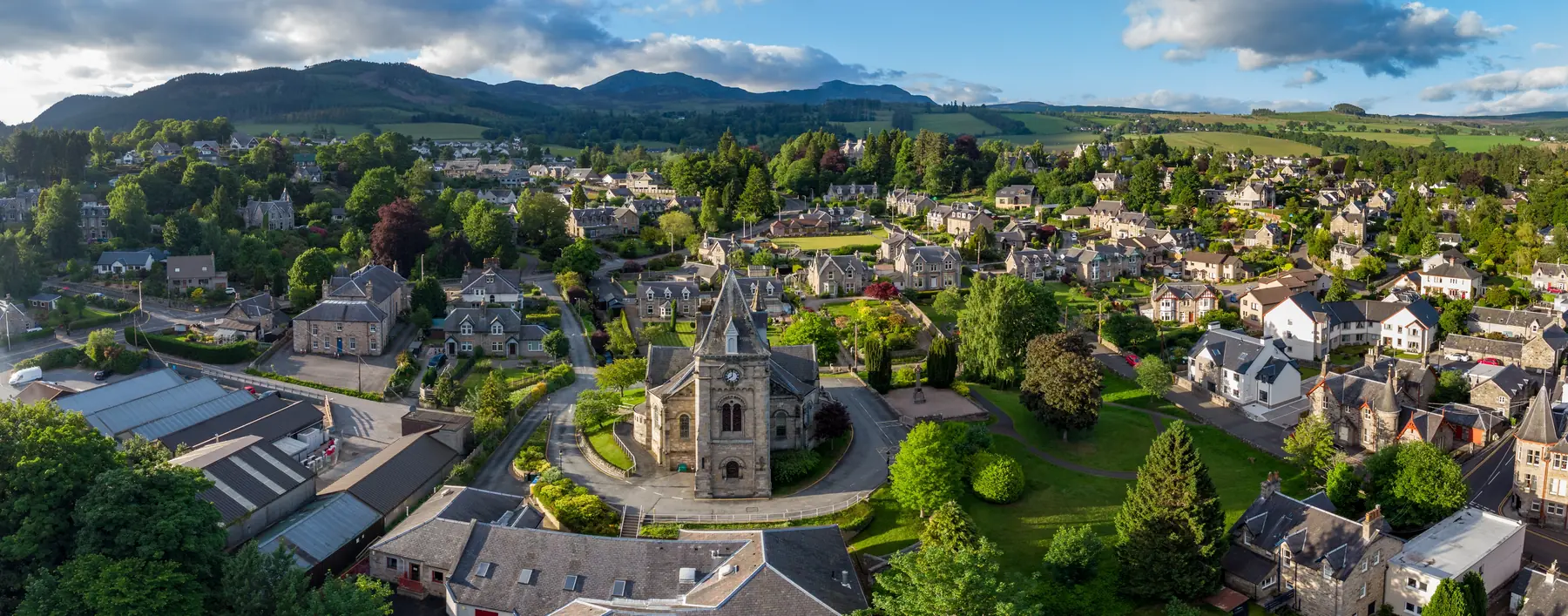
Pitlochry sits on the A9 halfway between Perth and Inverness, at the point where the Lowlands become the Highlands. That position is the town’s whole reason for existing — it has been a staging post on this route since long before the railway — and it makes it an unusually good base for day trips in every direction.
Perth is forty-five minutes south, Aviemore an hour north, Stirling an hour and a quarter, and Edinburgh and Glasgow both about two hours. The A9 is fast but heavily average-speed-camera’d and single carriageway for long stretches; allow more time than the distance suggests.
Ten kilometres. A white-harled castle with more than thirty rooms open — armour, portraits, a ballroom hung with antlers — set in a deer park with walled gardens and woodland walks. The Dukes of Atholl keep the Atholl Highlanders, the only private army in Europe. The village has a working watermill, a country life museum and a caravan park.
Half a day at least, and the best single visit within twenty kilometres.
Fifteen kilometres. A gorge of waterfalls with paths and bridges climbing beside them, and a shopping complex at the bottom. Twenty minutes to the lower falls; an hour and a half for the full circuit.
Beyond Blair Atholl, Glen Tilt runs north-east into the Cairngorms — a long, beautiful glen and the start of one of the great through-routes to Deeside. Aviemore and the Cairngorm plateau are an hour north on the A9.
Fourteen kilometres west, above Loch Tummel: the classic Perthshire view down the loch to the cone of Schiehallion. There is a Forestry and Land Scotland visitor centre and woodland trails.
The most shapely mountain in Perthshire and one of the most-climbed hills in Scotland, 1,083 metres, with a well-made path. It is also where the Reverend Nevil Maskelyne conducted an experiment in 1774 to weigh the Earth, in the course of which contour lines were invented.
The road runs west along Loch Tummel and Loch Rannoch to Rannoch Station, an isolated halt on the West Highland Line at the edge of Rannoch Moor. It is a dead end by road and one of the emptiest places in Britain reachable by train.
Eighteen kilometres. A small cathedral town on the Tay with a ruined cathedral in a riverside close, a National Trust street of restored houses, and the Hermitage just outside — Ossian’s Hall standing over the Black Linn waterfall among some of the tallest trees in Britain. Birnam across the bridge has the ancient Birnam Oak, a survivor of the wood Shakespeare sent to Dunsinane, and a Beatrix Potter exhibition.
Forty-five kilometres, forty-five minutes, or half an hour by train. Scone Palace, where the kings of Scots were crowned on the Stone of Destiny, is on the edge of the city; the Black Watch Castle and Museum, the art gallery and the riverside are in it. Kinnoull Hill above the town has a folly and a view over the Tay.
An hour east. The V&A Dundee on the waterfront, Discovery Point with Scott’s ship, and beyond it the Angus coast and the fishing towns.
Stirling is an hour and a quarter — the castle on its crag, the Wallace Monument and the Bannockburn battlefield. The Trossachs and Loch Lomond are an hour and a half, and Glencoe about two hours.
Pitlochry has two distilleries of its own, but the southern Highland whisky trail runs from here: Aberfeldy, twenty-five kilometres west, has Dewar’s Aberfeldy Distillery with a substantial visitor experience, and Glenturret near Crieff claims to be Scotland’s oldest working distillery. Speyside proper is an hour and a half north-east.
Pitlochry is on the main line from Edinburgh and Glasgow via Perth, with trains every hour or two continuing north to Blair Atholl, Kingussie, Aviemore and Inverness. The station is in the middle of the village. There is one direct daytime train from London King’s Cross, taking six and a half hours, and the Caledonian Sleeper from Euston arrives around six in the morning.
Buses are useful too: Citylink runs five services a day from Edinburgh in about two hours, continuing to Aviemore and Inverness, and six a day from Glasgow. Local services run north to Blair Atholl via Killiecrankie and south to Dunkeld and Perth. The main stop is by Fishers Hotel on Atholl Road.
That covers Blair Atholl, Dunkeld, Perth and Aviemore without a car. Loch Tummel, Rannoch and the Trossachs are harder. Our getting here page has more.
The Atholl day. North to Killiecrankie for the gorge and Soldier’s Leap, on to Blair Atholl for the castle and the watermill, and back via the Falls of Bruar. Twenty-five kilometres of driving in total and a full day of gorges, castles and waterfalls.
The Tummel and Rannoch road. West past the Linn of Tummel to Queen’s View, along Loch Tummel to Kinloch Rannoch and the length of Loch Rannoch to Rannoch Station at the edge of the moor. A dead end, an hour and a half each way, and one of the great empty drives in Scotland.
The Dunkeld day. South to Dunkeld for the cathedral and the National Trust street, the Hermitage for the folly and the tall trees, and Birnam for the oak and the Beatrix Potter exhibition. Twenty kilometres, half a day, and the best short walk in Perthshire in the middle of it.
The A9 is the spine of everything here and it has particular characteristics: average-speed cameras for long stretches, single carriageway with intermittent dual sections, and heavy summer traffic including caravans. Overtaking opportunities are limited and journey times are longer than the mileage implies.
The trains are frequently the better option — Perth, Dunkeld, Blair Atholl, Aviemore and Inverness are all on the line through the village, and the journey north through the Drumochter pass is a good deal more pleasant from a carriage than from behind a lorry.
Highland Perthshire gives you options most bases do not. Clear days belong on the hills and at the viewpoints: Queen’s View, Schiehallion, Ben Vrackie, the Loch Rannoch road. Cloudy days belong in the glens and gorges, where the interest is close at hand and low cloud makes the woods more atmospheric rather than less: Killiecrankie, the Hermitage, Bruar, the Linn of Tummel.
Wet days belong indoors — Blair Castle, the distilleries, the theatre — or in Perth and Dundee, which are both under an hour and both have serious museums.
And in October, everything belongs in the woods, because the colour is the point and it does not care about the forecast.
Blair Castle for a half day; Dunkeld and the Hermitage for the best short walk in Perthshire; Queen’s View and Loch Tummel for the scenery.
About forty-five kilometres south, forty-five minutes by road or half an hour by train.
Yes — Aviemore is an hour north by road and on the same railway line.
Yes, from the car park on the Braes of Foss road, in about four hours round trip on a good path.
About two hours by road, or a little under two by train with a change at Perth on some services.