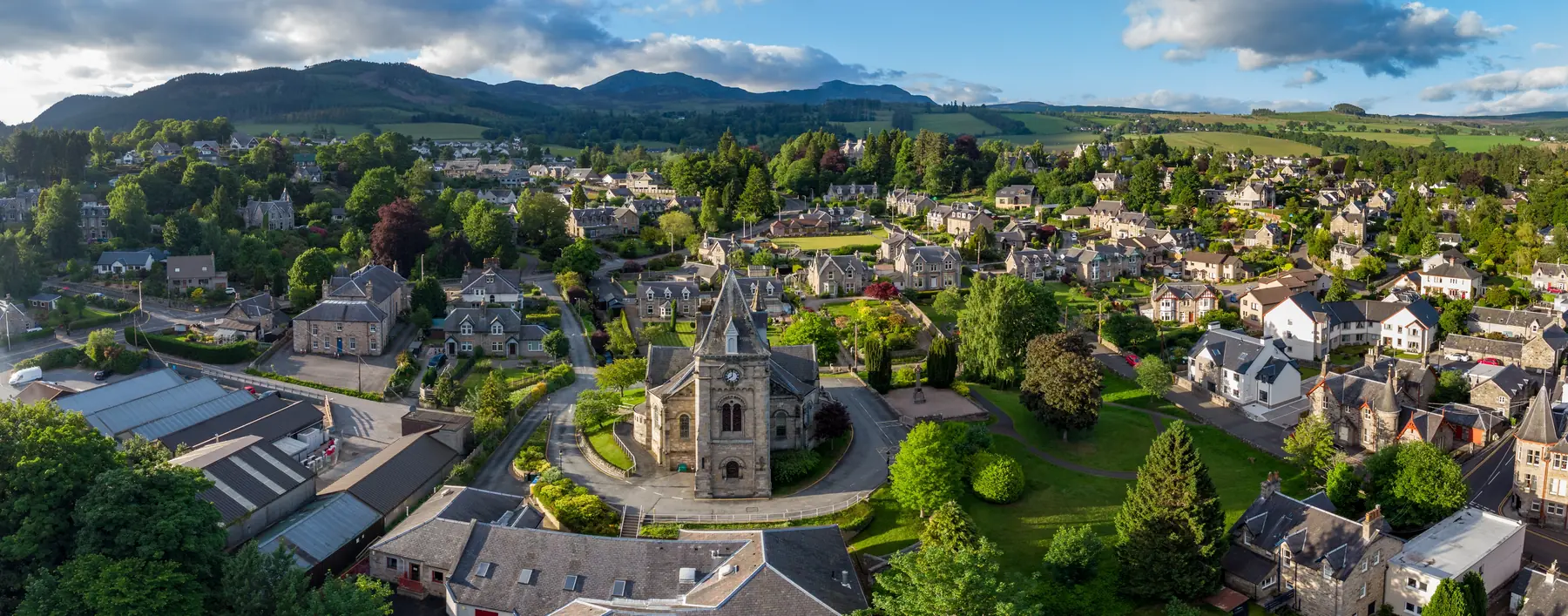
Highland Perthshire is the best place in Britain to see autumn colour, and Pitlochry is at the middle of it. The reason is a mixture of geography and Victorian ambition: this is a valley of native birch and rowan overlaid with the larch, beech and Douglas fir that nineteenth-century landowners planted on an enormous scale, in a climate that produces a long, slow turn rather than a single frost-driven collapse.
The area markets itself as Big Tree Country, which is unusually honest as slogans go. Some of the tallest trees in Britain are within twenty kilometres of the town.
The turn runs from late September to early November, and it moves. Broadly:
Late September — the first birches go, and the rowans are in berry. The larch is still green.
Early to mid October — the peak in most years. Birch gold, beech copper, larch turning, and the Faskally and Killiecrankie woods at their best.
Late October — the larch comes into its own, which is the distinctive Perthshire note: whole hillsides of it turning a burnt orange that conifers are not supposed to do.
Early November — the last of it, with bare birch and the light very low.
It varies by a fortnight either way depending on the summer and the first frosts. If you are travelling specifically for it, mid-October is the safest bet.
The town’s own wood, on the shore of the loch a kilometre from the high street, and the classic. Mixed planting of birch, beech, larch and oak on a loch shore, with the eight-kilometre circuit path running through it. It is where the Enchanted Forest is staged, and there is a reason they chose it.
Eighteen kilometres south. Douglas firs of over sixty metres, Ossian’s Hall standing over the Black Linn waterfall, and the beech and birch of the Braan gorge turning around them. It is the most visited short walk in Perthshire and in October it is very busy — go early.
Five kilometres north. The gorge of the Garry, steep-sided and heavily wooded, with the river below and the old railway viaduct above. The National Trust for Scotland path along it is one of the best colour walks in Scotland.
Three and a half kilometres north-west, where the two rivers meet among old woodland. Quieter than Killiecrankie and just as good.
Fourteen kilometres west. The classic view down the loch to Schiehallion, with the whole valley wooded on both sides. The forest drive and the trails around Allean run through larch and Scots pine.
Fifteen kilometres north. The gorge and its planted woodland — planted, as it happens, because Burns asked for it — with the falls running well after autumn rain.
Both within a couple of kilometres of the town, both wooded, and both far quieter than the named attractions.
Through October, Faskally Wood hosts a large sound-and-light installation — trees lit, projections on the loch, music composed for the event, and a walk of about a kilometre through it in the dark.
It is a substantial production and it has become one of Scotland’s best-attended autumn events. It is ticketed, it is timed, and it sells out weeks in advance. If you want to go, book as soon as tickets are released.
Practical points: it runs in the evening, it is cold, the path is uneven in places, and there is a park-and-ride from Pitlochry because the forest car park cannot take the numbers.
Colour is not the only thing happening.
The salmon run. Salmon climb the Pitlochry fish ladder to spawn upstream through the autumn, and the underwater viewing chamber is free. The counter beside it shows the year’s tally.
The deer rut. From late September into October, red deer stags roar across the glens — Glen Tilt, the Atholl estates and the hills around Loch Tummel are the places to hear it. Keep well away from the animals; a rutting stag is dangerous.
Fungi. Perthshire’s woods are exceptional for it, and the Highland Perthshire fungi season draws specialists. Look, photograph, and do not eat anything you cannot identify with certainty.
Dark skies. The nights lengthen and highland Perthshire has very little light pollution — the Loch Tummel and Rannoch road is one of the better accessible stargazing areas in Scotland.
Book accommodation early. October is Pitlochry’s second high season and the Enchanted Forest fills the town.
The weather is variable and can be superb — clear, cold, still days with the light very low. It can equally rain for a week. Waterproofs and boots.
Photography. Early morning for mist on the loch; late afternoon for the low light through the birches. Overcast days are better than bright ones for colour photography, which is a useful thing to know in Scotland.
Driving. The A9 and the Queen’s View road are busy at weekends in October. Go midweek if you can.
Colour reports. Forestry and Land Scotland and the local tourism bodies publish updates through the season, which are worth checking before travelling a long way for it.
Worth understanding, because it is not an accident. Three things combine.
Native woodland. The valley floors and hillsides carry birch, rowan, aspen and oak — birch in particular turns a clean gold and holds it for weeks.
Victorian planting. Highland Perthshire landowners planted on an enormous scale in the nineteenth century, and they planted for effect: beech, larch, and the Douglas firs brought back by David Douglas, who was born at Scone near Perth. That is why the area has some of the tallest trees in Britain and why the colour is layered rather than uniform.
Larch. The distinctive Perthshire note. Larch is a deciduous conifer, and in late October whole hillsides of it turn a burnt orange — a thing conifers are not supposed to do, and the reason the display here runs later than in most of Britain.
Climate does the rest: a maritime autumn with a slow cooling rather than a sudden frost gives a long, gradual turn instead of a week of glory and then bare branches.
If you are here for the colour and have a car, the display extends well past the town.
Glen Lyon, an hour west, is the longest enclosed glen in Scotland and turns spectacularly, with almost nobody in it.
Loch Tay and Kenmore, forty minutes south-west, have the Crannog Centre and a wooded lochside road.
The Birks of Aberfeldy, twenty-five kilometres west, is a circular gorge walk through birch woodland that Burns wrote a song about — the name means the birches, and October is what he was describing.
Glen Tilt at Blair Atholl, running north-east into the Cairngorms, is birch and larch for its first several kilometres and then open hill.
Dunkeld and the Tay valley south of the town carry the biggest trees.
Mid-October in most years, though the season runs from late September to early November and shifts by a fortnight depending on the weather.
Faskally Forest and the Loch Faskally circuit for accessibility; the Hermitage at Dunkeld for the trees; Killiecrankie for the gorge.
A large sound-and-light installation staged in Faskally Wood through October. It is ticketed, timed and sells out well in advance.
Yes, at the Pitlochry fish ladder, free, with an underwater viewing chamber. Autumn is the main run.
Yes — it is the second high season here. Book accommodation and Enchanted Forest tickets well ahead.