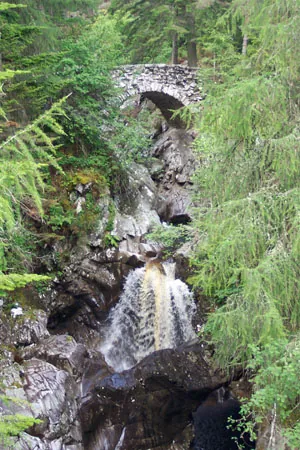
The Falls of Bruar are a series of waterfalls on the Bruar Water, fifteen kilometres north-west of Pitlochry near Blair Atholl, running down a narrow granite gorge with paths on both sides and bridges above and below.
They have been a tourist attraction since the eighteenth century, which is unusually early, and the reason involves a poem.
Robert Burns visited in 1787 during his Highland tour and found the falls magnificent and the setting bare — the hillsides had been stripped of trees for grazing and timber.
He wrote The Humble Petition of Bruar Water to the Noble Duke of Atholl, in which the river itself addresses the Duke and asks, politely and at length, to be given some trees:
The poem is a request for planting: shade, birches, willows, somewhere for birds to sing.
The 4th Duke of Atholl read it and did as he was asked. He planted the gorge with Scots pine and larch, laid out paths, and built the two bridges and the viewing points that are still there.
It is one of the very few cases in which a poem has demonstrably produced a landscape, and the wood you walk through is the result.
The Murrays of Atholl were prodigious planters — the 4th Duke is credited with putting in something in the order of fourteen million trees, largely larch, and effectively founding commercial forestry in the Highlands.
A circuit of about 2.5 kilometres, up one side of the gorge and back down the other, crossing at the upper and lower bridges.
The paths are well made and well maintained — this is a designed eighteenth-century walk and it shows — but they are steep in places, with a substantial climb to the upper bridge and a lot of steps.
Allow an hour at a steady pace, more if you stop.
The falls themselves are best after rain: a series of chutes and pools through pink granite, with the water compressed into slots. In dry weather they are modest; in spate they are excellent.
The upper bridge is the classic viewpoint, looking straight down the gorge.
The falls are reached from the House of Bruar car park, which is free — and which is itself a substantial retail complex selling Scottish clothing, food and country goods, with a large food hall and a restaurant.
This is either a convenience or an intrusion depending on your view. Practically, it means excellent facilities at the start of a Highland gorge walk: toilets, a good food hall for picnic supplies, and coffee.
The walk to the lower falls begins immediately behind the shop.
Free, open at all times.
Parking: free at the House of Bruar.
Time: an hour for the full circuit.
Facilities: everything at the House of Bruar — food hall, restaurant, toilets, shops.
Access: the lower section to the first bridge is manageable for some; the upper circuit has many steps and steep sections and is not accessible.
Footwear: proper shoes. The paths are good but steep and can be slippery.
Best time: after heavy rain, and in autumn for the larch colour.
Blair Castle is five minutes away at Blair Atholl.
Glen Tilt, one of the great Highland glens, runs north from Blair Atholl.
The Pass of Killiecrankie is fifteen minutes south.
Because Robert Burns asked him to, in a poem written after his 1787 visit in which the river petitions for trees. The 4th Duke planted the gorge accordingly.
About 2.5 kilometres round the gorge, taking roughly an hour, with steep sections and steps.
Yes, with free parking at the House of Bruar.
The lower section partly; the upper circuit is not — there are many steps and steep gradients.
After heavy rain. In dry weather they are much reduced.