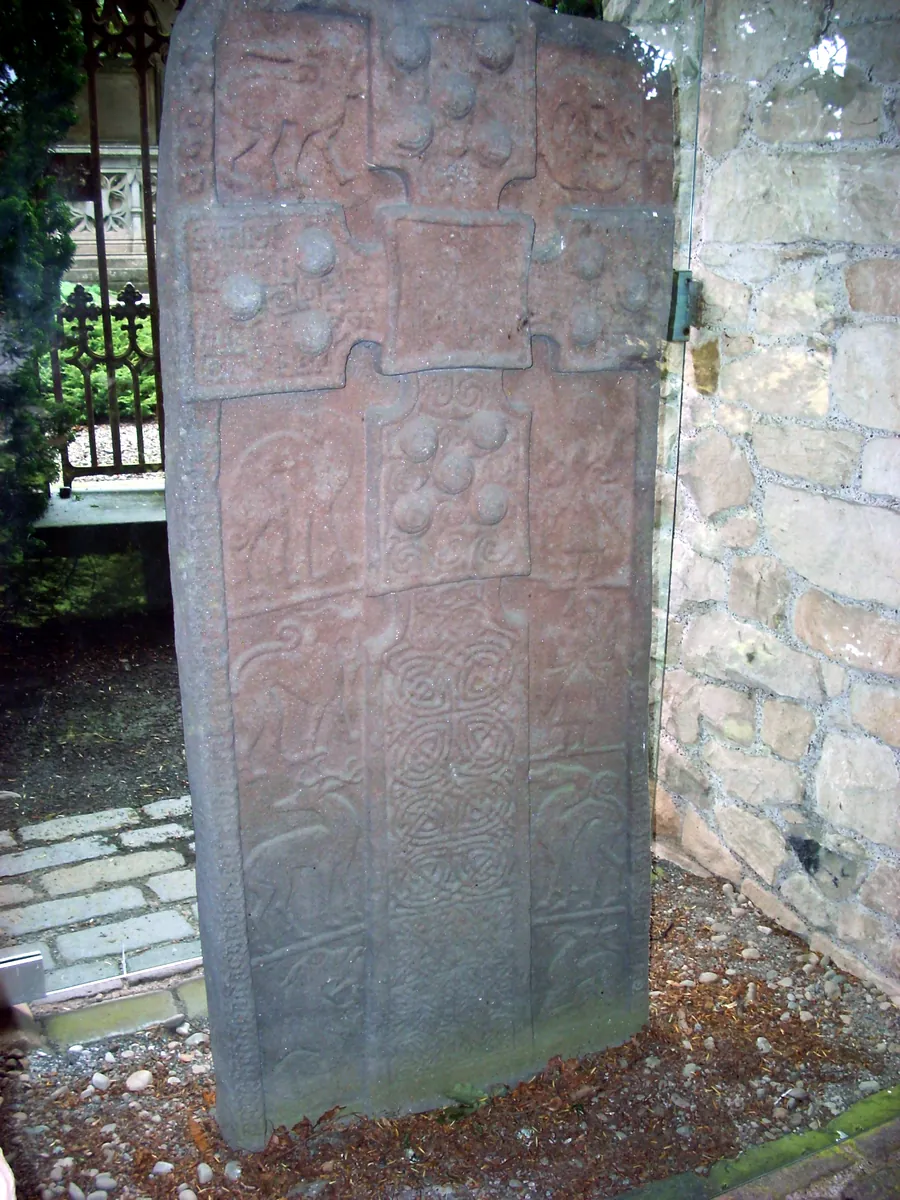
The Dunfallandy Stone stands on a hillside about two kilometres south of Pitlochry, in a small enclosure beside a burial ground, reached by a farm track and a few steps.
It is a Pictish cross-slab, carved around AD 800, and it is one of the finest examples of Pictish sculpture in Perthshire.
Almost nobody visits it, which is most of the point.
One face carries a ringed cross in high relief, decorated with interlace and key patterns, flanked by beasts and angels.
The other face is the interesting one. It shows:
Two seated figures facing each other, apparently ecclesiastics, with a cross between them.
A horseman below, riding to the right.
Pictish symbols — the double disc and Z-rod, the crescent and V-rod, and animal forms — carved alongside the Christian imagery.
A hammer, anvil and tongs in one corner, which may indicate a smith or may be symbolic.
The combination is what makes Pictish stones remarkable: Christian iconography and an undeciphered indigenous symbol system on the same slab, made by people who evidently saw no contradiction.
Nobody knows what the Pictish symbols mean. The leading suggestions are that they record names, lineages or ranks — a system of identification rather than a script — but the reading is not settled, and the Picts left no written explanation.
About twenty minutes’ walk from the centre of Pitlochry.
The route runs south along a quiet country road, then up a farm track, and finally up a few steps to the enclosure at the top.
There is a small cemetery beside the stone, and good views down the valley over the Tummel.
There is very limited parking on the narrow road, so walking is the sensible option — and the walk out of Pitlochry along the river and up the hill is pleasant in itself.
The stone is housed in a modern glass and metal shelter to protect it from weather, which does its job and slightly dampens the atmosphere. It is a compromise every exposed carved stone in Scotland eventually faces.
There is an information board.
It takes ten minutes to look at properly, and the walk there and back is the substance of the outing — call it an hour and a half in total.
Because it is 1,200 years old, it is outdoors, it is free, it is unattended, and you will very likely be the only person there.
Pitlochry is a busy town in season. The Dunfallandy Stone is a twenty-minute walk from the middle of it and is one of the few things in the area you can have entirely to yourself on an August afternoon.
Free, open at all times.
Time: ninety minutes including the walk from town.
Facilities: none.
Access: a farm track and steps at the end; not accessible.
Underfoot: the track is rough and can be muddy.
Historic Environment Scotland cares for the monument.
Pitlochry Dam and the fish ladder are on the way, at the bottom of the hill.
The Black Spout waterfall, a 60-metre fall in woodland, is a similar short walk from the other side of town.
Edradour Distillery, one of Scotland’s smallest, is three kilometres east.
Around AD 800 — a Pictish cross-slab of the late Pictish period.
A ringed cross on one face; on the other, two seated ecclesiastics, a horseman, and Pictish symbols including the double disc and Z-rod and the crescent and V-rod.
Nobody knows. The leading theory is that they record names or lineages, but there is no accepted reading.
Twenty minutes’ walk south from Pitlochry along a quiet road, then up a farm track and a few steps. Parking is very limited.
Yes, free and open at all times.