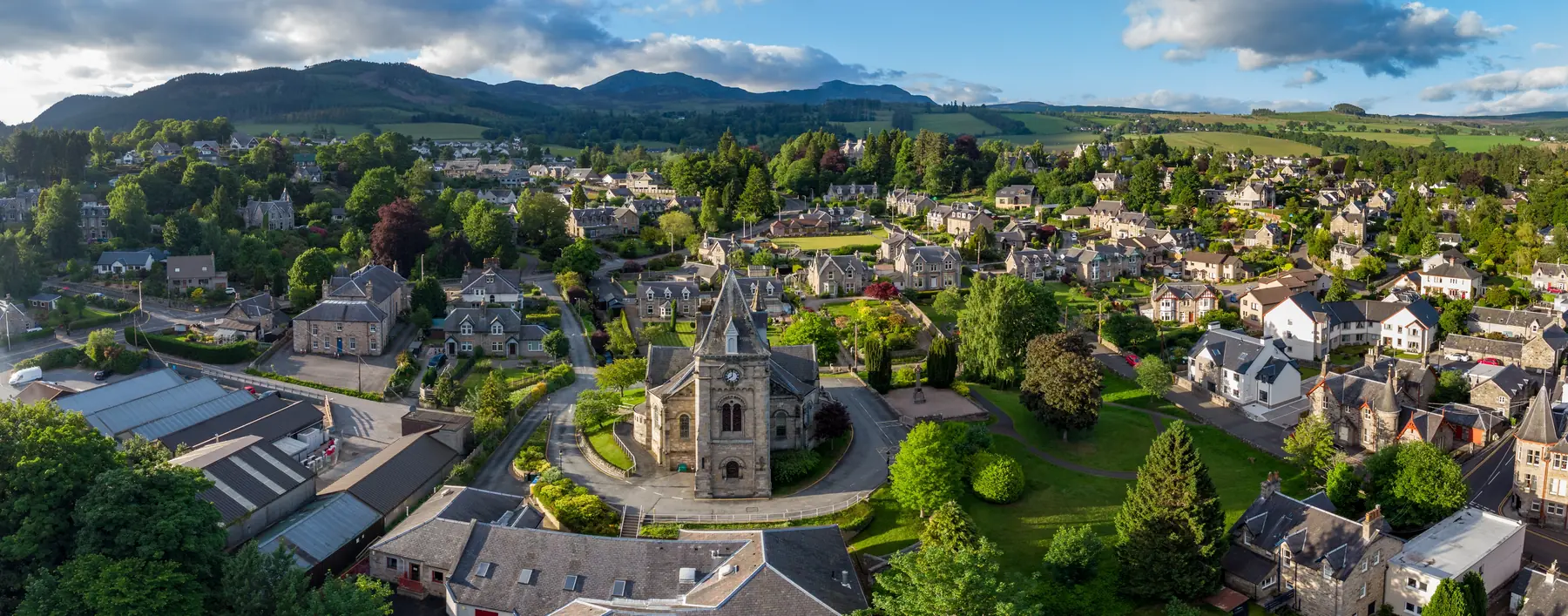
Pitlochry has two working whisky distilleries within a couple of kilometres of its high street, and they could hardly be less alike. One is a substantial Victorian operation supplying one of the world’s best-known blends; the other is a farm-scale distillery that for many years described itself as the smallest in Scotland and still works on a scale you can take in at a glance.
Doing both in a day is the obvious thing to do here, and it is a good introduction to how Scotch is actually made — because the difference in size makes the process visible in a way that a single visit does not.
On the southern edge of the town, on the road towards Perth, about a kilometre from the high street.
Blair Athol is one of the older working distilleries in Scotland — founded in the late eighteenth century, refounded and rebuilt since — and its single malt is a component of a very widely sold blend, which is why the visitor centre is as substantial as it is. The buildings are handsome grey stone around a courtyard, with the pagoda roof of the old maltings still in place.
Tours run through the day and cover the full process, ending in a tasting. There are longer and more specialised tours for those who want to go deeper, and a well-stocked shop.
It is the more polished of the two visits and the better one if you have not been round a distillery before.
Three kilometres east of the town, up a single-track road through the fields — walkable in about forty-five minutes from the high street, and a pleasant walk.
Edradour is the small one. For a long time it billed itself as the smallest distillery in Scotland, and while a wave of new micro-distilleries has complicated that claim, the point stands: it is a whitewashed cluster of farm buildings around a burn, with equipment at the lower limit of what is commercially viable and a workforce you could count on your fingers.
The reason to go is that you can see everything. In a large distillery the mash tun and the washbacks are industrial vessels in a hall; here the whole process is laid out at a scale a person can grasp, and the tour is correspondingly hands-on. Edradour also bottles a range of heavily peated and cask-finished whiskies under a second name, which broadens the tasting considerably.
Walk or drive to Blair Athol in the morning for the classic tour. Have lunch in the town. Walk out to Edradour in the afternoon — it is uphill but not steep, and the lane is quiet — and take the smaller tour there. Walk back down into Pitlochry for dinner.
That is a good day, it involves about six kilometres of walking, and it means nobody has to drive.
A practical point about driving: Scotland’s drink-drive limit is lower than England’s and is strictly enforced. Distilleries offer drivers’ samples to take away, and the walk-or-taxi approach is much the easier one.
Book ahead in summer and in October, when Pitlochry is at its busiest. Tours run to a timetable and both distilleries can fill.
Ages. Under-eighteens are generally welcome on tours but not in tastings, and there are usually minimum ages for the more specialised experiences. Check when booking.
Photography is restricted inside the production areas at most distilleries for safety reasons.
Shops. Both have distillery-exclusive bottlings, which are the reason a good number of people come.
Pitlochry is at the southern end of a good deal of Scotch geography.
Aberfeldy, twenty-five kilometres west, has Dewar’s Aberfeldy Distillery with the largest visitor experience in the area — a proper museum of blending as well as a distillery tour.
Glenturret, near Crieff to the south-west, claims to be the oldest working distillery in Scotland and now has a restaurant with a serious reputation attached.
Dalwhinnie, an hour north on the A9, is one of the highest distilleries in Scotland and sits in some of its bleakest and most memorable country.
Speyside — Glenlivet, Glenfiddich, Aberlour and the rest — begins about an hour and a half north-east, and is a trip in its own right rather than a day out.
Pitlochry’s hotel bars carry deep ranges of Scotch and several offer tasting flights, which is a cheaper way to try several than buying bottles. The Moulin Hotel, a kilometre north in the old village, brews its own beer as well and is the best bar in the area for an evening.
The whisky shops on Atholl Road stock independent bottlings and older expressions, and the staff in them know their subject.
For anyone new to it: malted barley is mashed with hot water to extract sugars, fermented with yeast in washbacks to make a beer of around eight per cent, distilled twice in copper stills to concentrate the alcohol, and then matured in oak casks — legally for at least three years, in practice for a good deal longer — during which the wood does most of the work on flavour.
Everything that distinguishes one malt from another happens in the details: the shape of the stills, the cut points the stillman chooses, the water, the peat or absence of it, and above all the casks. Seeing two distilleries of very different sizes in one day makes those variables considerably easier to understand than reading about them.
A note for anyone starting out. Scotch is conventionally divided into regions, and the Highland region — which covers most of the mainland north of the Highland Line and includes both Pitlochry distilleries — is by far the largest and least uniform of them.
Broadly, Highland malts tend towards the fruity, malty and honeyed rather than the medicinal peat of Islay or the light grassy character of the Lowlands. Blair Athol’s own make is a fairly rich, nutty, sherried style; Edradour’s traditional bottling is creamy and fruity, and its second range is heavily peated, which rather undermines the tidiness of regional generalisation.
That is the useful lesson of doing both in a day: region tells you less than the stills, the casks and the choices made by the people running them.
If whisky is the reason you are here, Pitlochry works well as a base for a longer trip. Two distilleries in the village, Aberfeldy twenty-five kilometres west with Dewar’s substantial visitor experience, Glenturret near Crieff to the south-west, and Dalwhinnie an hour north on the A9 make five within an easy radius — enough for a proper long weekend without moving hotels.
Add the Moulin Hotel’s microbrewery and the whisky ranges in the town’s hotel bars, and there is more to drink here than in places with a much bigger reputation for it.
The train helps: the main line runs through the village, so Dalwhinnie in one direction and Perth in the other are both reachable without driving.
Two — Blair Athol on the edge of the town and Edradour three kilometres east.
Yes, in about forty-five minutes uphill from the high street, on a quiet single-track lane.
It long claimed to be, and it remains one of the smallest traditional distilleries, though a number of new micro-distilleries have since opened.
In summer and in October, yes. Both run to a timetable and both fill.
Distilleries provide drivers’ samples to take away. Scotland’s drink-drive limit is lower than England’s and strictly enforced — walking or a taxi is the sensible choice.