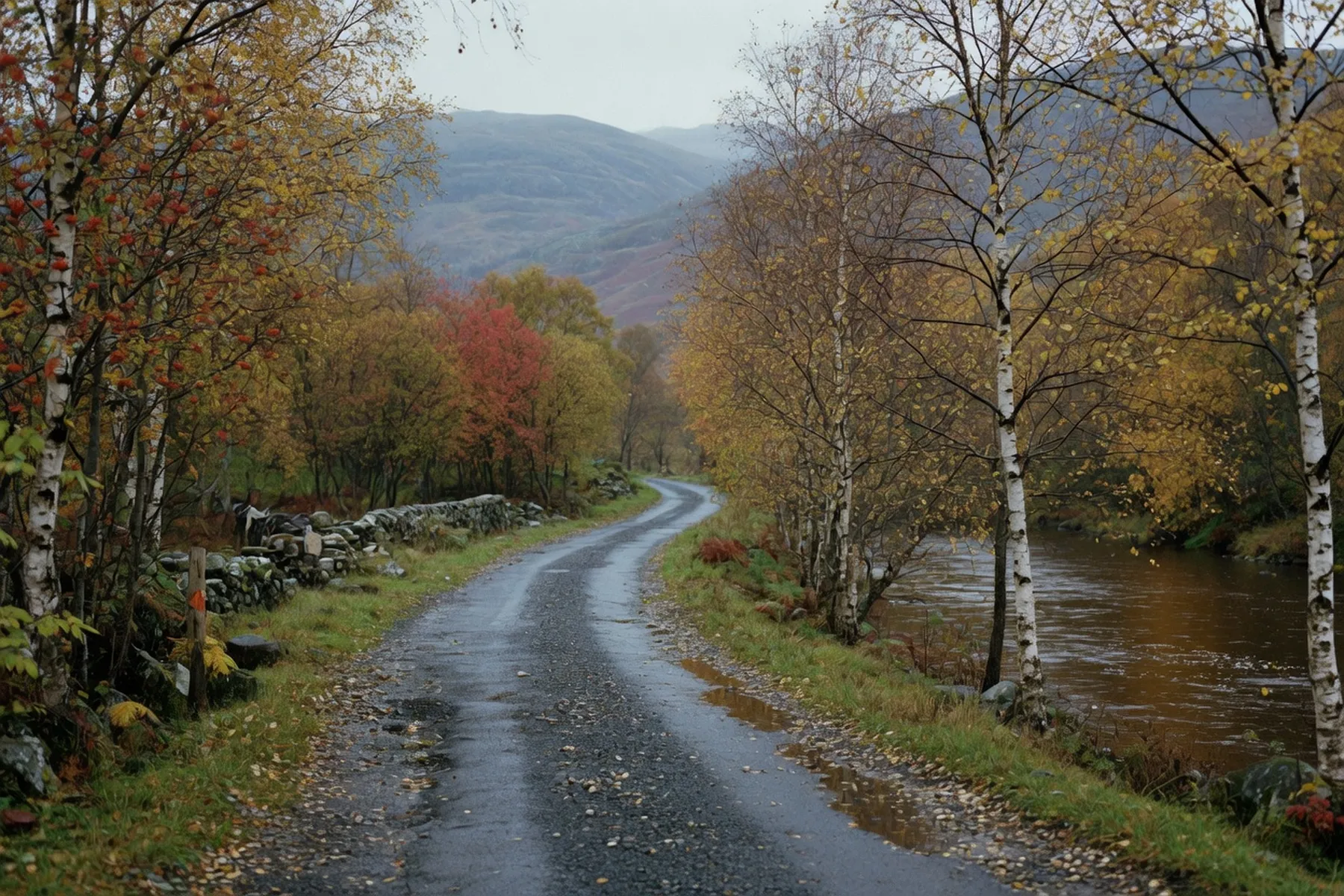
Blair Castle & Gardens sits one railway stop north of Pitlochry, in the village of Blair Atholl, and it is the rare day trip that begins the moment you sit down on the train. The castle is white against the hills, home to the Atholl family for more than seven hundred years. The village below has two rivers and a historic trail of its own, and four miles up the road the Falls of Bruar give the day a natural second act. This is how to do it without a car, what it actually costs, and when it actually closes.
Blair Atholl is the next stop north of Pitlochry on the Highland Main Line. The castle’s own visitor page describes the station as within walking distance of the castle, and it is not overstating it: turn right out of the station, walk a short distance, and the castle drive gates come up on your left. Cross the road, go up the drive, and the ticket office is about fifteen minutes from the platform. How often the trains run is a clock-time question, and clock times change, so check National Rail or ScotRail on the day rather than copying a column from anywhere else. The journey is short enough that the castle and the village make a full day from Pitlochry, with the station walk as the opening leg.
A local bus run by Elizabeth Yule Transport links Pitlochry and the House of Bruar with the castle, dropping and picking up in the castle car park several times a day, Monday to Saturday. If you would rather stop in the village first, the same service serves the Atholl Arms Hotel, a fifteen-minute walk from the ticket office. On Sundays the setup changes: the Stagecoach 83 from the House of Bruar, Pitlochry and Aberfeldy drops at the Atholl Arms Hotel instead. This two-bus arrangement — Yule through the week, Stagecoach on Sundays — is the part most guides get wrong, and the times move with the season, so read the operators’ own pages or Traveline Scotland before you plan around a particular bus. The wider no-car network is mapped in the without a car piece.
If you do drive, it is straightforward: north on the A9 past Pitlochry to the Blair Atholl junction, and the castle is signed. Coming the other way, leave at the House of Bruar junction and the castle appears on your left after about three miles. The car park is at the castle itself, which is also where the weekday bus drops you. For most people staying in Pitlochry, the train or the bus is the easier option, and it removes the only dull part of the day, which is sitting on the A9.
The castle began around 1269, built by John I Comyn, Lord of Badenoch, as a stronghold to control the way through the Highlands. What you walk into today is a very different building: over the centuries it moved from medieval fortress to stately home, the seat of the Murray family and later the Dukes of Atholl. It is white, and it is one of the most recognisable houses in Scotland. During the 1745 rebellion it was occupied by both Jacobite and government forces at different points. Inside, expect grand halls and accumulated family history rather than a single restored period — seven centuries of one family, told in the castle’s own voice rather than as a theme-park Highland laird’s house.
The gardens run from formal Victorian planting to wild woodland paths, and they are a day on their own if you skip the house. A garden-only ticket is cheaper than the house-and-garden one, which matters if you have already been inside or you are travelling with someone who wants the trees and not the stairs. The Victorian formality sits close to the house; further out, the planted order gives way to what was always there. The estate sits in its landscape rather than being fenced off from it, so the woodland paths read as part of the countryside around the village, not a manicured backdrop.
The Atholl Highlanders are the only remaining private army in Europe, the personal bodyguard of the Duke of Atholl, who is Chief of Clan Murray and whose family has been in Perthshire for some 750 years. They are not part of the British Army: they answer to the Duke and are based at Blair Castle. Joining is by invitation from the Duke, who selects people with ties to the estate or the local area, and the regiment runs to about a hundred men including the band, all of whom have to reach a reasonable standard of foot and arms drill.
The regiment was first raised in Perthshire in December 1777 by John Murray, the 4th Duke, as the 77th Regiment of Foot — the Atholl Highlanders, or Murray’s Highlanders — formed as relief for regiments in North America, though it spent most of its life in Ireland. It was re-formed as a private bodyguard in 1839 by George Murray, the 6th Duke, taken to the Eglinton Tournament, and in 1844 it mounted guard for the whole of Queen Victoria’s stay at Blair Castle. After 1933 it fell into abeyance, and it was Iain Murray, the 10th Duke, who brought it back in 1966: eight local men were invited, seven accepted, and they paraded at the castle on 8 April that year for the first time in 33 years.
The annual parade is normally the last weekend of May, with the Atholl Gathering — the estate’s Highland games, in Target Park on the east side of the drive — on the Sunday after. In 2026 the parade fell on 23 May and the Gathering on 24 May, both now past; the next comes at the end of May 2027. The games include tossing the caber and throwing the hammer. Confirm the dates on the Atholl Estates page before you plan a visit around them.
The castle and gardens open every day from 1 April to 30 October 2026, and then it closes for the winter — a fact plenty of other sites soften into “most of the year”. Tickets are cheaper online in advance than on arrival: an adult is £20.00 online against £21.00 on arrival, and a child aged 5 to 16 is £12.50 online against £13.50 on arrival. On arrival the castle is card-only. Family and concession tiers exist, but the tier-to-price mapping is best read on the ticketing page rather than quoted from a blog, and garden-only prices sit below the house-and-garden figures. One thing worth knowing before you buy: a house-and-garden ticket can be converted to annual membership at no extra cost — pay today, visit all season, in the estate’s own phrase.
Three dates in the last month of the season close early. Monday 5 October closes at 1.00pm with last entry at 12.00pm. Wednesday 28 and Thursday 29 October close at 3.00pm with last entry at 2.00pm. On those days plan the house first and the gardens after.
Blair Atholl and Bridge of Tilt is the largest village in the area, bounded on the south by the River Garry and cut through by its tributary, the River Tilt — the left-bank side is what locals call Bridge of Tilt. The name Blair Atholl comes from the Gaelic Blàr Athall, “the plain of Atholl”, and Atholl was once a powerful medieval earldom that controlled the routes between north and south Scotland. The village keeps a historic trail of its own, plus local walks, Blair Atholl Golf, white-water rafting, salmon fishing and cycling, so the castle is not the only reason to step off the train. Give the trail and the river an hour, not just the road to the ticket office.
Four miles north of the village sit the hamlets of Bruar, Calvine and Struan, where the A9 and the railway begin their climb through Drumochter Pass into Badenoch. The Falls of Bruar and the House of Bruar are the natural extension of the day, and they sit on the same bus route that serves the castle. The falls are a short walk from the road; the House of Bruar is a Perthshire institution for food and shopping, and a useful place to eat if the castle’s food cabin is not open. Doing both in a day works only if you check the return bus times before you get off — the last bus matters more than the first.
As of 16 September 2026 the castle is in the final weeks of its season, open daily to 30 October. The Cannon, the outdoor food cabin, opens on certain Saturdays — 10 October and 24 October among them — and takes card only. No winter opening is published, so after 30 October treat the castle as shut. For anything added late, go to the Atholl Estates visitor page rather than assuming.